


Page 36 - (DK Eyewitness) Travel Guide - Australia
P. 36
34 INTRODUCING A USTR ALIA
Aboriginal Culture
Far from being one homogeneous race, at the time of
European settlement in the 18th century, the estimated
750,000 Aborigines in Australia had at least 300 different
languages and a wide variety of lifestyles, depending on
where they lived. The tribes of northern coastal areas, such
as the Tiwis, had most contact with outsiders, especially
from Indonesia, and their culture was quite different from the
more isolated Pitjantjatjaras of Central Australia’s deserts or
the Kooris from the southeast. However, there were features
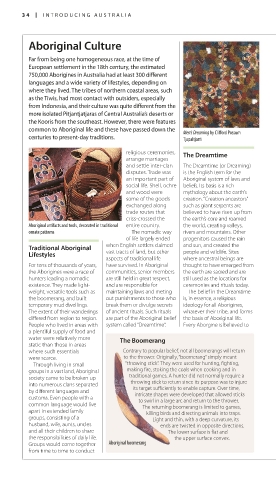
common to Aboriginal life and these have passed down the Men’s Dreaming by Clifford Possum
centuries to present-day traditions. Tjapaltjarri
religious ceremonies, The Dreamtime
arrange marriages
and settle interclan The Dreamtime (or Dreaming)
disputes. Trade was is the English term for the
an important part of Aboriginal system of laws and
social life. Shell, ochre beliefs. Its basis is a rich
and wood were mythology about the earth’s
some of the goods creation. “Creation ancestors”
exchanged along such as giant serpents are
trade routes that believed to have risen up from
crisscrossed the the earth’s core and roamed
Aboriginal artifacts and tools, decorated in traditional entire country. the world, creating valleys,
ornate patterns The nomadic way rivers and mountains. Other
of life largely ended progenitors caused the rain
Traditional Aboriginal when English settlers claimed and sun, and created the
Lifestyles vast tracts of land, but other people and wildlife. Sites
aspects of traditional life where ancestral beings are
For tens of thousands of years, have survived. In Aboriginal thought to have emerged from
the Aborigines were a race of communities, senior members the earth are sacred and are
hunters leading a nomadic are still held in great respect, still used as the locations for
existence. They made light and are responsible for ceremonies and rituals today.
weight, versatile tools such as maintaining laws and meting The belief in the Dreamtime
the boomerang, and built out punishments to those who is, in essence, a religious
temporary mud dwellings. break them or divulge secrets ideology for all Aborigines,
The extent of their wanderings of ancient rituals. Such rituals whatever their tribe, and forms
differed from region to region. are part of the Aboriginal belief the basis of Aboriginal life.
People who lived in areas with system called “Dreamtime”. Every Aborgine is believed to
a plentiful supply of food and
water were relatively more The Boomerang
static than those in areas
where such essentials Contrary to popular belief, not all boomerangs will return
were scarce. to the thrower. Originally, “boomerang” simply meant
Through living in small “throwing stick”. They were used for hunting, fighting,
groups in a vast land, Aboriginal making fire, stoking the coals when cooking and in
society came to be broken up traditional games. A hunter did not normally require a
into numerous clans separated throwing stick to return since its purpose was to injure
by different languages and its target sufficiently to enable capture. Over time,
intricate shapes were developed that allowed sticks
customs. Even people with a to swirl in a large arc and return to the thrower.
common language would live The returning boomerang is limited to games,
apart in extended family killing birds and directing animals into traps.
groups, consisting of a Light and thin, with a deep curvature, its
husband, wife, aunts, uncles ends are twisted in opposite directions.
and all their children to share The lower surface is flat and
the responsibilities of daily life. the upper surface convex.
Groups would come together Aboriginal boomerang
from time to time to conduct

