


Page 215 - Encyclopedia of Aquarium and Pond Fish, 3rd Edition
P. 215
SELECTING THE DECOR    213

         invertebrates but are soon colonized and discolored by
         algae, which are hard to remove. Dead coral skeletons and
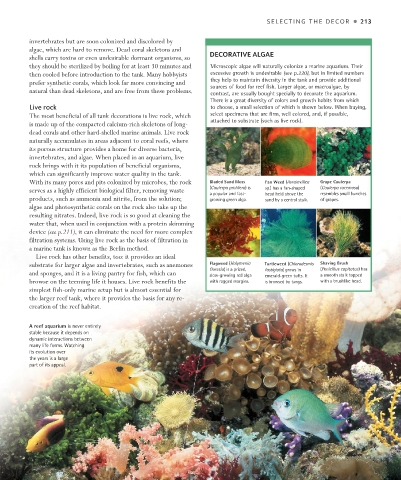
         shells carry toxins or even undesirable dormant organisms, so   DECORATIVE ALGAE
         they should be sterilized by boiling for at least 30 minutes and   Microscopic algae will naturally colonize a marine aquarium. Their
         then cooled before introduction to the tank. Many hobbyists   excessive growth is undesirable (see p.220), but in limited numbers
         prefer synthetic corals, which look far more convincing and   they help to maintain diversity in the tank and provide additional
         natural than dead skeletons, and are free from these problems.   sources of food for reef fish. Larger algae, or macroalgae, by
                                                           contrast, are usually bought specially to decorate the aquarium.
                                                           There is a great diversity of colors and growth habits from which
         Live rock                                         to choose, a small selection of which is shown below. When buying,
         The most beneficial of all tank decorations is live rock, which   select specimens that are firm, well colored, and, if possible,
         is made up of the compacted calcium-rich skeletons of long-   attached to substrate (such as live rock).
         dead corals and other hard-shelled marine animals. Live rock
         naturally accumulates in areas adjacent to coral reefs, where
         its porous structure provides a home for diverse bacteria,
         invertebrates, and algae. When placed in an aquarium, live
         rock brings with it its population of beneficial organisms,
         which can significantly improve water quality in the tank.
         With its many pores and pits colonized by microbes, the rock   Bladed Sand Moss   Fan Weed (Avrainvillea   Grape Caulerpa
         serves as a highly efficient biological filter, removing waste   (Caulerpa prolifera) is    sp.) has a fan-shaped   (Caulerpa racemosa)
                                                           a popular and fast-
                                                                                         resembles small bunches
                                                                          head held above the
         products, such as ammonia and nitrite, from the solution;   growing green alga.  sand by a central stalk.  of grapes.
         algae and photosynthetic corals on the rock also take up the
         resulting nitrates. Indeed, live rock is so good at cleaning the
         water that, when used in conjunction with a protein skimming
         device (see p.211), it can eliminate the need for more complex
         filtration systems. Using live rock as the basis of filtration in
         a marine tank is known as the Berlin method.
           Live rock has other benefits, too: it provides an ideal
         substrate for larger algae and invertebrates, such as anemones   Flagweed (Halymenia   Turtleweed (Chlorodesmis   Shaving Brush
         and sponges, and it is a living pantry for fish, which can   floresia) is a prized,   fastigiata) grows in   (Penicillus capitatus) has
                                                                                         a smooth stalk topped
                                                                          emerald-green tufts. It
                                                           slow-growing red alga
         browse on the teeming life it houses. Live rock benefits the   with ragged margins.  is browsed by tangs.  with a brushlike head.
         simplest fish-only marine setup but is almost essential for
         the larger reef tank, where it provides the basis for any re-
         creation of the reef habitat.

         A reef aquarium is never entirely
         stable because it depends on
         dynamic interactions between
         many life forms. Watching
         its evolution over
         the years is a large
         part of its appeal.


   US_212-213_Selecting_decor.indd   213                                                             29/08/18   4:10 PM

