


Page 216 - Encyclopedia of Aquarium and Pond Fish, 3rd Edition
P. 216
214    MARINE FISH: SETTING UP THE TANK

         Preparing the tank


         Assembling the components of the marine aquarium is straightforward,
         but there are a few important factors, such as the quality of your
         water supply, that must be considered if you are to achieve a
         successful result. Patience is vital; even under ideal conditions,
         it can take several months for conditions in the tank to become
         stable enough for the most delicate marine species.

         When setting up a marine tank, care must be taken not only
         to create the desired visual effect but also to consider the
         varied needs of the marine species you wish to keep. Once the
         substrate has been prepared (see pp.208–209), the next step is
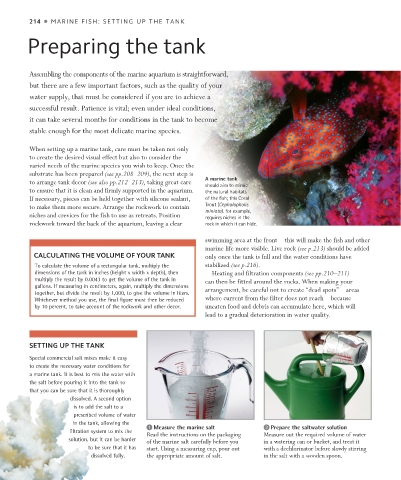
         to arrange tank decor (see also pp.212–213), taking great care   A marine tank
                                                          should aim to mimic
         to ensure that it is clean and firmly supported in the aquarium.    the natural habitats
         If necessary, pieces can be held together with silicone sealant,   of the fish; this Coral
         to make them more secure. Arrange the rockwork to contain   Trout (Cephalopholis
         niches and crevices for the fish to use as retreats. Position   miniata), for example,
                                                          requires niches in the
         rockwork toward the back of the aquarium, leaving a clear   rock in which it can hide.

                                                          swimming area at the front—this will make the fish and other
                                                          marine life more visible. Live rock (see p.213) should be added
          CALCULATING THE VOLUME OF YOUR TANK             only once the tank is full and the water conditions have
           To calculate the volume of a rectangular tank, multiply the   stabilized (see p.216).
           dimensions of the tank in inches (height x width x depth), then   Heating and filtration components (see pp.210–211)
           multiply the result by 0.0043 to get the volume of the tank in   can then be fitted around the rocks. When making your
           gallons. If measuring in centimeters, again, multiply the dimensions   arrangement, be careful not to create “dead spots”—areas
           together, but divide the result by 1,000, to give the volume in liters.
           Whichever method you use, the final figure must then be reduced   where current from the filter does not reach—because
           by 10 percent, to take account of the rockwork and other decor.  uneaten food and debris can accumulate here, which will
                                                          lead to a gradual deterioration in water quality.


         SETTING UP THE TANK
         Special commercial salt mixes make it easy
         to create the necessary water conditions for
         a marine tank. It is best to mix the water with
         the salt before pouring it into the tank so
         that you can be sure that it is thoroughly
                    dissolved. A second option
                     is to add the salt to a
                     prescribed volume of water
                     in the tank, allowing the
                                                                          2
                                          1
                    filtration system to mix the    1  Measure the marine salt   1  Prepare the saltwater solution
                                                                          Measure out the required volume of water
                                         Read the instructions on the packaging
                    solution, but it can be harder   of the marine salt carefully before you   in a watering can or bucket, and treat it
                         to be sure that it has   start. Using a measuring cup, pour out   with a dechlorinator before slowly stirring
                          dissolved fully.  the appropriate amount of salt.  in the salt with a wooden spoon.


   US_214-215_Setting_up_the_tank.indd   214                                                         29/08/18   4:10 PM

