


Page 213 - Encyclopedia of Aquarium and Pond Fish, 3rd Edition
P. 213
HEATING AND FILTRATION     211


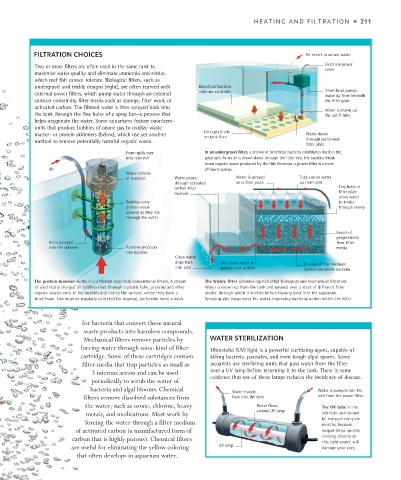
          FILTRATION CHOICES                                                         Air enters to aerate water
           Two or more filters are often used in the same tank to                          Electrical power
                                                                                           cable
           maximize water quality and eliminate ammonia and nitrite,
           which reef fish cannot tolerate. Biological filters, such as
           undergravel and trickle designs (right), are often teamed with   Beneficial bacteria   Powerhead pumps
           external power filters, which pump water through an external   colonize substrate  water up from beneath
           canister containing filter media such as sponge, filter wool, or                the filter plate
           activated carbon. The filtered water is then sprayed back into                  Water is drawn up
           the tank through the fine holes of a spray bar—a process that                   the uplift tube
           helps oxygenate the water. Some aquariums feature ozonizers—
           units that produce bubbles of ozone gas to oxidize waste
           matter—or protein skimmers (below), which use yet another   Filter plate sits   Water drawn
                                                         on tank floor
           method to remove potentially harmful organic waste.                       through perforated
                                                                                     filter plate
                                    Foam spills over     In an undergravel filter, a colony of beneficial bacteria establishes itself in the
                                    into reservoir       substrate. As water is drawn down through the filter bed, the bacteria break
                                                         down organic waste produced by the fish. However, a power filter is a more
              Air                                        efficient option.
                                    Waste collects
                                    in reservoir  Water passes    Water is sprayed   Tube carries water
                                                 through activated    onto filter plate  up from tank
                                                 carbon filter                                Tiny holes in
                                                 medium                                       filter plate
                                                                                              allow water
                                    Bubbles carry                                             to trickle
                                    protein waste                                             through slowly
                                    upward as they rise
                                    through the water
                                                                                              Layers of
                                                                                              progressively
               Air is pumped                                                                  finer filter
               into the skimmer     Airstone produces                                         media
                                    tiny bubbles
                                                 Clean water
                                                 drips back   Slit allows water to   Biological filter medium
                                                 into tank    pass to next section   harbors beneficial bacteria
           The protein skimmer works in a different way from conventional filters. A stream   The trickle filter provides sophisticated biological and mechanical filtration.
           of electrically charged air bubbles rises through a plastic tube; proteins and other   Water is drawn up from the tank and sprayed over a stack of different filter
           organic wastes stick to the bubbles and rise to the surface, where they form a   media, through which it trickles before flowing back into the aquarium.
           thick foam. This must be regularly collected for disposal, preferably twice a week.  Spraying also oxygenates the water, improving bacterial action within the filter.


                        for bacteria that convert these natural
                        waste products into harmless compounds.
                        Mechanical filters remove particles by   WATER STERILIZATION
                       forcing water through some kind of filter   Ultraviolet (UV) light is a powerful sterilizing agent, capable of
                       cartridge. Some of these cartridges contain   killing bacteria, parasites, and even tough algal spores. Some
                        filter media that trap particles as small as    aquarists use sterilizing units that pass water from the filter
                          3 microns across and can be used   over a UV lamp before returning it to the tank. There is some
                          periodically to scrub the water of   evidence that use of these lamps reduces the incidence of disease.
                          bacteria and algal blooms. Chemical    Water travels           Water is pumped into the
                        filters remove dissolved substances from   back into the tank    unit from the power filter
                         the water, such as ozone, chlorine, heavy      Water flows       The UV tube in the
                         metals, and medications. Most work by          around UV lamp    sterilizer unit should
                         forcing the water through a filter medium                        be replaced every six
                                                                                          months, because
                      of activated carbon (a manufactured form of                         output drops quickly.
                     carbon that is highly porous). Chemical filters                      Looking directly at
                                                                                          this light source will
                     are useful for eliminating the yellow coloring   UV lamp             damage your eyes.
                      that often develops in aquarium water.


   US_210-211_Heating_Filtration.indd   211                                                          29/08/18   4:10 PM

