


Page 246 - Encyclopedia of Aquarium and Pond Fish, 3rd Edition
P. 246
244    MARINE FISH DIRECTORY

         CLOWNFISH


         Clownfish are also known as anemonefish because
         of their close relationship with this group of marine
         invertebrates. This association may have developed
         because the anemones’ stinging cells kill the Oodinium
         skin parasites to which these fish are susceptible.
         Clownfish are one of the easiest marine species to
         breed in the home aquarium. Sexing, too,
         is no problem, because if you buy two
         juveniles, measuring no more than
         1 ⁄2 in (13 mm) long, then you can be sure
         of acquiring a true pair. Although all
         juveniles are male, the dominant individual of
         the two will change into a female as the fish mature.
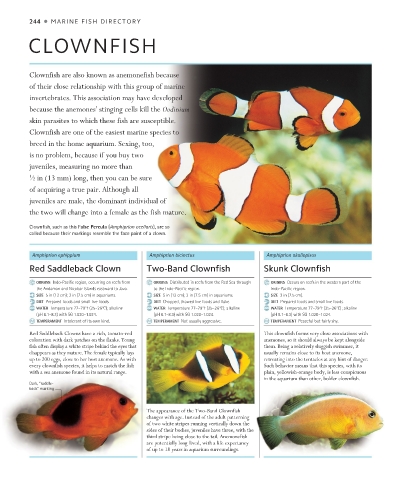
         Clownfish, such as this False Percula (Amphiprion ocellaris), are so
         called because their markings resemble the face paint of a clown.

          Amphiprion ephippium            Amphiprion bicinctus            Amphiprion akallopisos
         Red Saddleback Clown            Two-Band Clownfish               Skunk Clownfish

           ORIGINS  Indo-Pacific region, occurring on reefs from   ORIGINS  Distributed in reefs from the Red Sea through   ORIGINS  Occurs on reefs in the western part of the
           the Andaman and Nicobar Islands eastward to Java.  to the Indo-Pacific region.   Indo-Pacific region.
           SIZE  5 in (12 cm); 3 in (7.5 cm) in aquariums.  SIZE  5 in (12 cm); 3 in (7.5 cm) in aquariums.  SIZE  3 in (7.5 cm).
           DIET  Prepared foods and small live foods.  DIET  Chopped, thawed live foods and flake.  DIET  Prepared foods and small live foods.
           WATER  Temperature 77–79°F (25–26°C); alkaline    WATER  Temperature 77–79°F (25–26°C); alkaline    WATER  Temperature 77–79°F (25–26°C); alkaline
           (pH 8.1–8.3) with SG 1.020–1.024.   (pH 8.1– 8.3) with SG 1.020–1.024.  (pH 8.1–8.3) with SG 1.020–1.024.
           TEMPERAMENT  Intolerant of its own kind.  TEMPERAMENT  Not usually aggressive.  TEMPERAMENT  Peaceful but fairly shy.
         Red Saddleback Clowns have a rich, tomato-red                    This clownfish forms very close associations with
         coloration with dark patches on the flanks. Young                anemones, so it should always be kept alongside
         fish often display a white stripe behind the eyes that           them. Being a relatively sluggish swimmer, it
         disappears as they mature. The female typically lays             usually remains close to its host anemone,
         up to 200 eggs, close to her host anemone. As with               retreating into the tentacles at any hint of danger.
         every clownfish species, it helps to match the fish              Such behavior means that this species, with its
         with a sea anemone found in its natural range.                   plain, yellowish-orange body, is less conspicuous
                                                                          in the aquarium than other, bolder clownfish.
         Dark, “saddle-
         back” marking

                                         The appearance of the Two-Band Clownfish
                                         changes with age. Instead of the adult patterning
                                         of two white stripes running vertically down the
                                         sides of their bodies, juveniles have three, with the
                                         third stripe being close to the tail. Anemonefish
                                         are potentially long-lived, with a life expectancy
                                         of up to 18 years in aquarium surroundings.


   US_244-245_Clownfish.indd   244                                                                   29/08/18   4:10 PM

