


Page 20 - Encyclopedia of Aquarium and Pond Fish, 3rd Edition
P. 20
18    INTRODUCTION TO FISHKEEPING


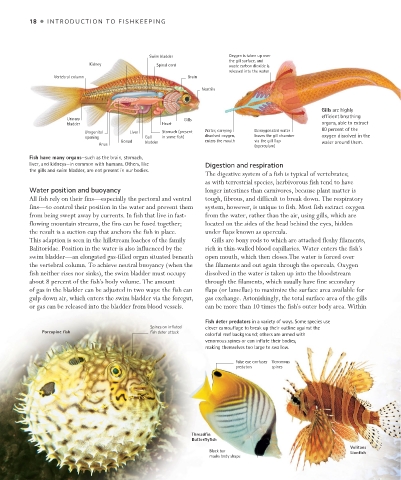
                                          Swim bladder          Oxygen is taken up over
                                                                the gill surface, and
                          Kidney            Spinal cord         waste carbon dioxide is
                                                                released into the water
                Vertebral column                     Brain
                                                         Nostrils

                                                                                          Gills are highly
                                                                                          efficient breathing
                    Urinary                         Gills
                    bladder                   Heart                                       organs, able to extract
                        Urogenital   Liver    Stomach (present   Water, carrying   Deoxygenated water   80 percent of the
                        opening          Gall   in some fish)  dissolved oxygen,   leaves the gill chamber   oxygen dissolved in the
                                  Gonad  bladder         enters the mouth  via the gill flap
                            Anus                                       (operculum)        water around them.
         Fish have many organs—such as the brain, stomach,
         liver, and kidneys—in common with humans. Others, like   Digestion and respiration
         the gills and swim bladder, are not present in our bodies.
                                                          The digestive system of a fish is typical of vertebrates;
                                                          as with terrestrial species, herbivorous fish tend to have
         Water position and buoyancy                      longer intestines than carnivores, because plant matter is
         All fish rely on their fins—especially the pectoral and ventral   tough, fibrous, and difficult to break down. The respiratory
         fins—to control their position in the water and prevent them   system, however, is unique to fish. Most fish extract oxygen
         from being swept away by currents. In fish that live in fast-  from the water, rather than the air, using gills, which are
         flowing mountain streams, the fins can be fused together;    located on the sides of the head behind the eyes, hidden
         the result is a suction cup that anchors the fish in place.    under flaps known as opercula.
         This adaption is seen in the hillstream loaches of the family   Gills are bony rods to which are attached fleshy filaments,
         Balitoridae. Position in the water is also influenced by the   rich in thin-walled blood capillaries. Water enters the fish’s
         swim bladder—an elongated gas-filled organ situated beneath   open mouth, which then closes.The water is forced over
         the vertebral column. To achieve neutral buoyancy (when the   the filaments and out again through the opercula. Oxygen
         fish neither rises nor sinks), the swim bladder must occupy   dissolved in the water is taken up into the bloodstream
         about 8 percent of the fish’s body volume. The amount    through the filaments, which usually have fine secondary
         of gas in the bladder can be adjusted in two ways: the fish can   flaps (or lamellae) to maximize the surface area available for
         gulp down air, which enters the swim bladder via the foregut,   gas exchange. Astonishingly, the total surface area of the gills
         or gas can be released into the bladder from blood vessels.   can be more than 10 times the fish’s outer body area. Within

                                                          Fish deter predators in a variety of ways. Some species use
                                          Spines on inflated   clever camouflage to break up their outline against the
             Porcupine fish               fish deter attack  colorful reef background; others are armed with
                                                          venomous spines or can inflate their bodies,
                                                          making themselves too large to swallow.

                                                                  False eye confuses   Venomous
                                                                  predators  spines


                                                      Threadfin
                                                      Butterflyfish
                                                                                                  Volitans
                                                           Black bar                              Lionfish
                                                           masks body shape


   US_016-019_What_is_fish_v2.indd   18                                                              29/08/18   4:08 PM

