


Page 21 - Encyclopedia of Aquarium and Pond Fish, 3rd Edition
P. 21
WHAT IS A FISH?    19

         the mouth, straining devices called gill rakers prevent
         food and debris from passing over and damaging the gills.
           Some fish also gulp atmospheric oxygen using the swim   SENSES AND COMMUNICATION
         bladder as a basic “lung.” These species are usually the natural   Although fish brains are poorly developed compared to those of
         inhabitants of muddy pools, where dissolved oxygen may    mammals, fish possess acute and often highly specialized senses
         be in short supply.                               and means of communication.
                                                           Barbels—structures on the lips
             Color and pattern                             that resemble elongated whiskers—
             Almost all fish use color to aid camouflage or to    are common in fish that live
                                                           in water where visibility is poor.
         attract mates. Some are colored with inconspicuous    Barbels may contain touch and
         browns and greens to blend in with the background and   taste organs that help the fish
                                                           navigate and find food.
         escape the attention of predators; others—such as the
         flatfish—change their pattern to match their background.    The lateral line runs down
         The brilliant colors displayed by many tropical species are    each side of the fish’s body. It
                                                           comprises a row of pores opening
         also a form of camouflage; bold vertical stripes, for example,   into a channel that leads to the
         break up the outline of a body and make it hard to see. And   head. The channel is filled with
         dark stripes through the eyes often continue through the    a viscous jelly, which detects
                                                           vibrations in the water.
         iris, making the eye almost invisible. Some fish have “false”
         eyespots (also called ocelli) on their tails; predators will    Fish eyes are similar to those of
         attack what they believe to be the head, giving the prey    other vertebrates and can see
                                                           colors. Vision is particularly
         a few moments to escape.                          sharp in fish that live close to
           Fish that have a solid, dark color tend to have lots    the surface. The Four-Eyes (see
         of pigment in their skin, while species that appear silvery    pp.156–157) can see in both air
                                                           and water at the same time.
         have little skin pigment but rely more on the iridescence of
         the scales. This reflectiveness is caused by the presence of the   Electrical fields produced by
         chemical guanine—a waste product from the blood. Many fish   mormyrids (see p.186), like this
                                                           Peter’s Elephant-Nose, enable fish
         have transparent bodies as fry and develop color only with age.  to sense their environment. Some
                                                           experiments suggest that the
                                                           electrical signals may also be
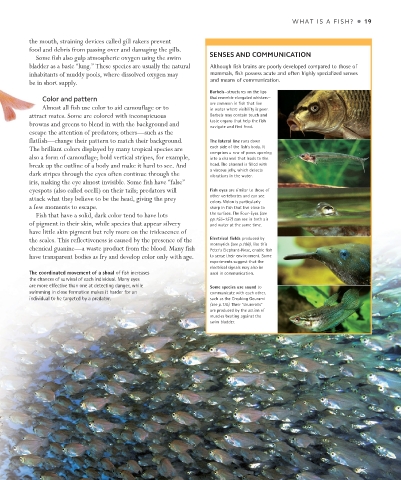
         The coordinated movement of a shoal of fish increases   used in communication.
         the chances of survival of each individual. Many eyes
         are more effective than one at detecting danger, while   Some species use sound to
         swimming in close formation makes it harder for an   communicate with each other,
         individual to be targeted by a predator.          such as the Croaking Gourami
                                                           (see p.110). Their “drumrolls”
                                                           are produced by the action of
                                                           muscles beating against the
                                                           swim bladder.


   US_016-019_What_is_fish_v2.indd   19                                                              29/08/18   4:08 PM

