


Page 22 - Encyclopedia of Aquarium and Pond Fish, 3rd Edition
P. 22
20    INTRODUCTION TO FISHKEEPING

         Evolution and classification


         Fish are the oldest of all vertebrates (animals with
         backbones), with an ancestry dating back more than 500
         million years. However, the earliest fish to appear in the
         world’s oceans were very different from those seen today,
         since they had no jaws or scales. They lacked specialized
         fins, so they relied solely on tail movements to propel
                                                          Lungfish, forming the family
         them through the water. Internally, their spine was    Ceratodiformes, have changed very
                                                          little in appearance since they first
         made of cartilage, rather than bone.             evolved more than 400 million years ago.

         The first scaly fish with movable jaws arose around 440 million   there were recognizable forerunners of many of today’s
         years ago, their jaws having evolved from the front gill arches.   freshwater species, including Hypsidoris, a primitive catfish
         These fish also possessed several pairs of spines along the lower   with sensory barbels and protective spines on its pectoral fins.
         sides of the body, from which paired fins later developed.
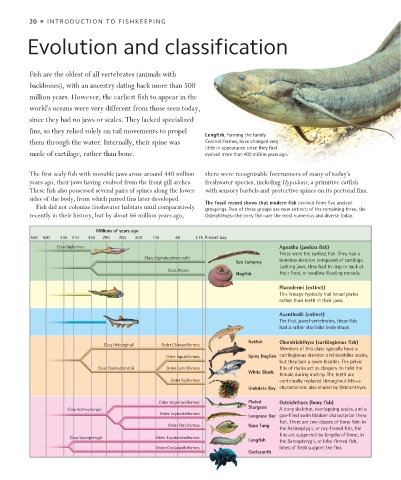
           Fish did not colonize freshwater habitats until comparatively   The fossil record shows that modern fish evolved from five ancient
                                                          groupings. Two of these groups are now extinct; of the remaining three, the
         recently in their history, but by about 66 million years ago,   Osteichthyes—the bony fish—are the most numerous and diverse today.
                            Millions of years ago
         550  500  435  410  355  295  250  203  135  65  1.75 Present day
                 Class Diplorhina                                             Agnatha (jawless fish)
                                                                              These were the earliest fish. They had a
                                         Class Cephalaspidomorphi             boneless skeleton composed of cartilage.
                                                                  Sea Lamprey
                                                                              Lacking jaws, they had to rasp or suck at
                                               Class Myxini
                                                                  Hagfish     their food, or swallow floating morsels.
                                                                              Placodermi (extinct)
                                                                              This lineage typically had broad plates
                                                                              rather than teeth in their jaws.

                                                                              Acanthodii (extinct)
                                                                              The first jawed vertebrates, these fish
                                                                              had a rather sharklike body shape.
                                                                      Ratfish  Chondrichthyes (cartilaginous fish)
                              Class Holocephali  Order Chimaeriformes
                                                                              Members of this class typically have a
                                               Order Squaliformes     Spiny Dogfish cartilaginous skeleton and toothlike scales,
                                                                              but they lack a swim bladder. The pelvic
                            Class Elasmobranchii  Order Lamniformes           fins of males act as claspers, to hold the
                                                                      White Shark
                                                                              female during mating. The teeth are
                                                Order Rajiformes              continually replaced throughout life—a
                                                                      Undulate Ray characteristic also shared by Osteichthyes.
                                             Order Acipenseriformes   Plated   Osteichthyes (bony fish)
                    Class Actinopterygii                              Sturgeon  A bony skeleton, overlapping scales, and a
                                             Order Lepisosteiformes   Longnose Gar gas-filled swim bladder characterize these
                                                                              fish. There are two classes of bony fish: in
                                               Order Perciformes      Naso Tang
                                                                              the Actinoptygii, or ray-finned fish, the
                                                                              fins are supported by lengths of bone; in
                    Class Sarcopterygii     Order Lepidosireniformes
                                                                      Lungfish  the Sarcopterygii, or lobe-finned fish,
                                            Order Coelacanthiformes           lobes of flesh support the fins.
                                                                      Coelacanth


   US_020-021_Classification.indd   20                                                               29/08/18   4:08 PM

