


Page 261 - Encyclopedia of Aquarium and Pond Fish, 3rd Edition
P. 261
BUTTERFLYFISH    259


          Chaetodon unimaculatus          Chaetodon tinkeri
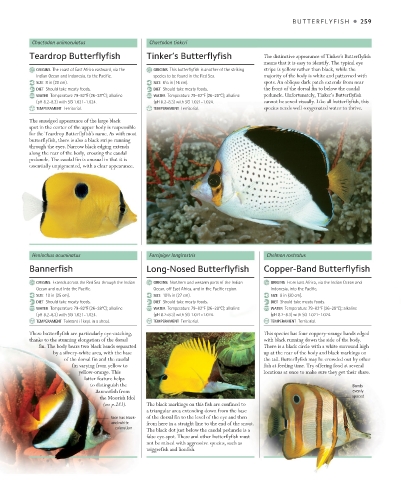
         Teardrop Butterflyfish          Tinker’s Butterflyfish           The distinctive appearance of Tinker’s Butterflyfish
                                                                          means that it is easy to identify. The typical eye
           ORIGINS  The coast of East Africa eastward, via the   ORIGINS  This butterflyfish is another of the striking   stripe is yellow rather than black, while the
           Indian Ocean and Indonesia, to the Pacific.   species to be found in the Red Sea.  majority of the body is white and patterned with
           SIZE  8 in (20 cm).             SIZE  6 ⁄4 in (16 cm).         spots. An oblique dark patch extends from near
                                               1
           DIET  Should take meaty foods.   DIET  Should take meaty foods.  the front of the dorsal fin to below the caudal
           WATER  Temperature 79–82°F (26–28°C); alkaline   WATER  Temperature 79–82°F (26–28°C); alkaline  peduncle. Unfortunately, Tinker’s Butterflyfish
           (pH 8.2–8.3) with SG 1.021–1.024.   (pH 8.2–8.3) with SG 1.021–1.024.  cannot be sexed visually. Like all butterflyfish, this
           TEMPERAMENT  Territorial.       TEMPERAMENT  Territorial.      species needs well-oxygenated water to thrive.
         The smudged appearance of the large black
         spot in the center of the upper body is responsible
         for the Teardrop Butterflyfish’s name. As with most
         butterflyfish, there is also a black stripe running
         through the eyes. Narrow black edging extends
         along the rear of the body, crossing the caudal
         peduncle. The caudal fin is unusual in that it is
         essentially unpigmented, with a clear appearance.


          Heniochus acuminatus            Forcipiger longirostris         Chelmon rostratus
         Bannerfish                      Long-Nosed Butterflyfish         Copper-Band Butterflyfish

           ORIGINS  Extends across the Red Sea through the Indian   ORIGINS  Northern and western parts of the Indian   ORIGINS  From East Africa, via the Indian Ocean and
           Ocean and out into the Pacific.   Ocean, off East Africa, and in the Pacific region.  Indonesia, into the Pacific.
                                               3
           SIZE  10 in (25 cm).            SIZE  10 ⁄4 in (27 cm).          SIZE  8 in (20 cm).
           DIET  Should take meaty foods.   DIET  Should take meaty foods.   DIET  Should take meaty foods.
           WATER  Temperature 79–82°F (26–28°C); alkaline   WATER  Temperature 79–82°F (26–28°C); alkaline   WATER  Temperature 79–82°F (26–28°C); alkaline
           (pH 8.2–8.3) with SG 1.021–1.024.   (pH 8.2–8.3) with SG 1.021–1.024.   (pH 8.2–8.3) with SG 1.021–1.024.
           TEMPERAMENT  Tolerant if kept in a shoal.  TEMPERAMENT  Territorial.  TEMPERAMENT  Territorial.
         These butterflyfish are particularly eye-catching,               This species has four coppery-orange bands edged
         thanks to the stunning elongation of the dorsal                  with black running down the side of the body.
            fin. The body bears two black bands separated                 There is a black circle with a white surround high
                by a silvery-white area, with the base                    up at the rear of the body and black markings on
                   of the dorsal fin and the caudal                       the tail. Butterflyfish may be crowded out by other
                     fin varying from yellow to                           fish at feeding time. Try offering food at several
                       yellow-orange. This                                locations at once to make sure they get their share.
                        latter feature helps
                          to distinguish the                                                      Bands
                           Bannerfish from                                                        evenly
                             the Moorish Idol                                                     spaced
                              (see p.281).   The black markings on this fish are confined to
                                         a triangular area extending down from the base
                                Face has black-    of the dorsal fin to the level of the eye and then
                                and-white   from here in a straight line to the end of the snout.
                                 coloration  The black dot just below the caudal peduncle is a
                                         false eye-spot. These and other butterflyfish must
                                         not be mixed with aggressive species, such as
                                         triggerfish and lionfish.


   US_258-259_Butterflyfish.indd   259                                                               29/08/18   4:10 PM

