


Page 259 - Encyclopedia of Aquarium and Pond Fish, 3rd Edition
P. 259
BUTTERFLYFISH    257


          Chaetodon auriga                Chaetodon ephippium             Chaetodon collare
         Threadfin Butterflyfish         Saddleback Butterflyfish         Red-Tail Butterflyfish

           ORIGINS  Ranges from East Africa through the Indian   ORIGINS  Ranges from East Africa through the Indian   ORIGINS  From East Africa, via Indonesia, north to Japan
           Ocean and into the Pacific.     ocean and into the Pacific.      and south to Australia’s eastern coast.
                                               3
           SIZE  6 ⁄4 in (17 cm).          SIZE  6 ⁄4 in (17 cm).           SIZE  7 in (18 cm).
              3
           DIET  Should take meaty foods.   DIET  Should take meaty foods.   DIET  Should take meaty foods.
           WATER  Temperature 79–82°F (26–28°C); alkaline   WATER  Temperature 79–82°F (26–28°C); alkaline   WATER  Temperature 79–82°F (26–28°C); alkaline
           (pH 8.2–8.3) with SG 1.021–1.024.  (pH 8.2–8.3) with SG 1.021–1.024.   (pH 8.2–8.3) with SG 1.021–1.024.
           TEMPERAMENT  Territorial.       TEMPERAMENT  Territorial.        TEMPERAMENT  Territorial.
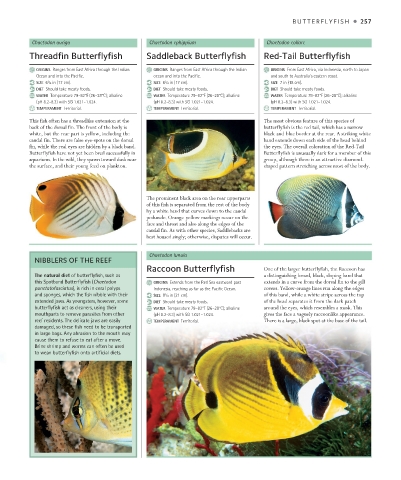
         This fish often has a threadlike extension at the                The most obvious feature of this species of
         back of the dorsal fin. The front of the body is                 butterflyfish is the red tail, which has a narrow
         white, but the rear part is yellow, including the                black-and-blue border at the rear. A striking white
         caudal fin. There are false eye-spots on the dorsal              band extends down each side of the head behind
         fin, while the real eyes are hidden by a black band.             the eyes. The overall coloration of the Red-Tail
         Butterflyfish have not yet been bred successfully in             Butterflyfish is unusually dark for a member of this
         aquariums. In the wild, they spawn toward dusk near              group, although there is an attractive diamond-
         the surface, and their young feed on plankton.                   shaped pattern stretching across most of the body.


                                         The prominent black area on the rear upperparts
                                         of this fish is separated from the rest of the body
                                         by a white band that curves down to the caudal
                                         peduncle. Orange-yellow markings occur on the
                                         face and throat and also along the edges of the
                                         caudal fin. As with other species, Saddlebacks are
                                         best housed singly; otherwise, disputes will occur.

                                          Chaetodon lunula
           NIBBLERS OF THE REEF
                                         Raccoon Butterflyfish            One of the larger butterflyfish, the Raccoon has
           The natural diet of butterflyfish, such as                     a distinguishing broad, black, sloping band that
           this Spotband Butterflyfish (Chaetodon   ORIGINS  Extends from the Red Sea eastward past   extends in a curve from the dorsal fin to the gill
           punctatofasciatus), is rich in coral polyps    Indonesia, reaching as far as the Pacific Ocean.   covers. Yellow-orange lines run along the edges
           and sponges, which the fish nibble with their   SIZE  8 ⁄4 in (21 cm).  of this band, while a white stripe across the top
                                               1
           extended jaws. As youngsters, however, some   DIET  Should take meaty foods.   of the head separates it from the dark patch
           butterflyfish act as cleaners, using their   WATER  Temperature 79–82°F (26–28°C); alkaline   around the eyes, which resembles a mask. This
           mouthparts to remove parasites from other   (pH 8.2–8.3) with SG 1.021–1.024.   gives the face a vaguely raccoonlike appearance.
           reef residents. The delicate jaws are easily   TEMPERAMENT  Territorial.  There is a large, black spot at the base of the tail.
           damaged, so these fish need to be transported
           in large bags. Any abrasion to the mouth may
           cause them to refuse to eat after a move.
           Brine shrimp and worms can often be used
           to wean butterflyfish onto artificial diets.


   US_256-257_Butterflyfish.indd   257                                                               29/08/18   4:10 PM

