


Page 263 - Encyclopedia of Aquarium and Pond Fish, 3rd Edition
P. 263
GOBIES    261


          Nemateleotris magnifica         Valenciennea strigata           Valenciennea puellaris
         Firefish                        Yellowhead Sleeper Goby          Orange-Spotted Sleeper Goby

           ORIGINS  From East Africa eastward through the Indo-   ORIGINS  From East Africa eastward through the Indo-   ORIGINS  The western Pacific, north to the Ryukyu
           Pacific region, north to Japan and south to Australia.   Pacific region, north to Japan and south to Australia.    Islands and south to Australia’s Great Barrier Reef.
              3
           SIZE  2 ⁄4 in (7 cm).           SIZE  7 in (18 cm).              SIZE  3 in (7.5 cm).
           DIET  Small crustaceans.        DIET  Small invertebrates.       DIET  Small invertebrates.
           WATER  Temperature 77–79°F (25–26°C); alkaline  WATER  Temperature 77–79°F (25–26°C); alkaline  WATER  Temperature 77–79°F (25–26°C); alkaline
           (pH 8.1–8.3) with SG 1.020–1.024.  (pH 8.1–8.3) with SG 1.020–1.024.  (pH 8.1–8.3) with SG 1.020–1.024.
           TEMPERAMENT  Social.            TEMPERAMENT  Social.             TEMPERAMENT  Reasonably social.
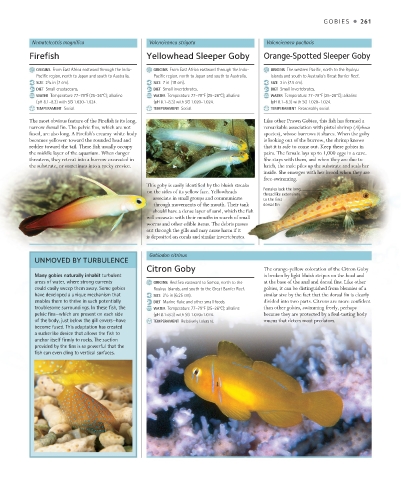
         The most obvious feature of the Firefish is its long,            Like other Prawn Gobies, this fish has formed a
         narrow dorsal fin. The pelvic fins, which are not                remarkable association with pistol shrimp (Alpheus
         fused, are also long. A Firefish’s creamy-white body             species), whose burrows it shares. When the goby
         becomes yellower toward the rounded head and                     is looking out of the burrow, the shrimp knows
         redder toward the tail. These fish usually occupy                that it is safe to come out. Keep these gobies in
         the middle layer of the aquarium. When danger                    pairs. The female lays up to 1,000 eggs in a cave.
         threatens, they retreat into a burrow excavated in               She stays with them, and when they are due to
         the substrate, or sometimes into a rocky crevice.                hatch, the male piles up the substrate and seals her
                                                                          inside. She emerges with her brood when they are
                                                                          free-swimming.
                                         This goby is easily identified by the bluish streaks
                                          on the sides of its yellow face. Yellowheads   Females lack the long,
                                                                          threadlike extensions
                                           associate in small groups and communicate   to the first
                                           through movements of the mouth. Their tank   dorsal fin
                                           should have a dense layer of sand, which the fish
                                         will excavate with their mouths in search of small
                                         worms and other edible items. The debris passes
                                         out through the gills and may cause harm if it
                                         is deposited on corals and similar invertebrates.

                                          Gobiodon citrinus
           UNMOVED BY TURBULENCE
                                         Citron Goby                      The orange-yellow coloration of the Citron Goby
           Many gobies naturally inhabit turbulent                        is broken by light bluish stripes on the head and
           areas of water, where strong currents    ORIGINS  Red Sea eastward to Samoa, north to the   at the base of the anal and dorsal fins. Like other
           could easily sweep them away. Some gobies    Ryukyu Islands, and south to the Great Barrier Reef.  gobies, it can be distinguished from blennies of a
           have developed a unique mechanism that   SIZE  2 ⁄2 in (6.25 cm).  similar size by the fact that the dorsal fin is clearly
                                               1
           enables them to thrive in such potentially   DIET  Marine flake and other small foods.  divided into two parts. Citrons are more confident
           troublesome surroundings. In these fish, the   WATER  Temperature 77–79°F (25–26°C); alkaline   than other gobies, swimming freely, perhaps
           pelvic fins—which are present on each side    (pH 8.1–8.3) with SG 1.020–1.024.   because they are protected by a foul-tasting body
           of the body, just below the gill covers—have   TEMPERAMENT  Relatively tolerant.  mucus that deters most predators.
           become fused. This adaptation has created
           a suckerlike device that allows the fish to
           anchor itself firmly to rocks. The suction
           provided by the fins is so powerful that the
           fish can even cling to vertical surfaces.


   US_260-261_Gobies.indd   261                                                                      29/08/18   4:10 PM

