


Page 256 - Encyclopedia of Aquarium and Pond Fish, 3rd Edition
P. 256
254    MARINE FISH DIRECTORY


          Pomacanthus maculosus                                           Pomacanthus semicirculatus
         Yellow Bar Angelfish                                             Koran Angelfish

           ORIGINS  Throughout the Persian Gulf and Red Sea,                ORIGINS  Widely distributed, ranging from the Red Sea
           extending into northwestern parts of the Indian Ocean.           throughout the Indo-Pacific region.
           SIZE  12 in (30 cm).                                             SIZE  16 in (40 cm).
           DIET  Animal-based foods and plant matter.                       DIET  Eats both plant and animal matter.
           WATER  Temperature 77–79°F (25–26°C); alkaline                   WATER  Temperature 77–79°F (25–26°C); alkaline
           (pH 8.1–8.3) with SG 1.020–1.025.                                (pH 8.1–8.3) with SG 1.020–1.024.
           TEMPERAMENT  Bold and fearless.                                  TEMPERAMENT  Territorial.
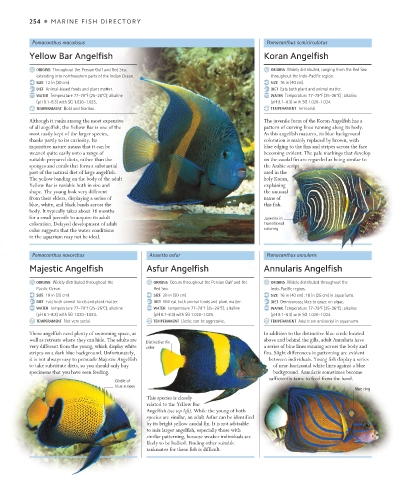
         Although it ranks among the most expensive                       The juvenile form of the Koran Angelfish has a
         of all angelfish, the Yellow Bar is one of the                   pattern of curving lines running along its body.
         most easily kept of the larger species,                          As this angelfish matures, its blue background
         thanks partly to its curiosity. Its                              coloration is mainly replaced by brown, with
         inquisitive nature means that it can be                          blue edging to the fins and stripes across the face
         weaned quite easily onto a range of                              becoming evident. The pale markings that develop
         suitable prepared diets, rather than the                         on the caudal fin are regarded as being similar to
         sponges and corals that form a substantial                       the Arabic script
         part of the natural diet of large angelfish.                     used in the
         The yellow banding on the body of the adult                      holy Koran,
         Yellow Bar is variable both in size and                          explaining
         shape. The young look very different                             the unusual
         from their elders, displaying a series of                        name of
         blue, white, and black bands across the                          this fish.
         body. It typically takes about 18 months
         for a small juvenile to acquire its adult                        Juvenile in
         coloration. Delayed development of adult                         transitional
         color suggests that the water conditions                         coloring
         in the aquarium may not be ideal.

          Pomacanthus navarchus           Arusetta asfur                  Pomacanthus annularis
         Majestic Angelfish              Asfur Angelfish                  Annularis Angelfish

           ORIGINS  Widely distributed throughout the    ORIGINS  Occurs throughout the Persian Gulf and the    ORIGINS  Widely distributed throughout the
           Pacific Ocean.                  Red Sea.                         Indo-Pacific region.
           SIZE  10 in (25 cm).            SIZE  20 in (50 cm).             SIZE  16 in (40 cm); 10 in (25 cm) in aquariums.
           DIET  Eats both animal foods and plant matter.   DIET  Will eat both animal foods and plant matter.  DIET  Omnivorous; likes to graze on algae.
           WATER  Temperature 77–79°F (25–26°C); alkaline    WATER  Temperature 77–79°F (25–26°C); alkaline    WATER  Temperature 77–79°F (25–26°C); alkaline
           (pH 8.1–8.3) with SG 1.020–1.024.  (pH 8.1–8.3) with SG 1.020–1.025.  (pH 8.1–8.3) with SG 1.020–1.024.
           TEMPERAMENT  Not very social.   TEMPERAMENT  Lively; can be aggressive.  TEMPERAMENT  Adults are antisocial in aquariums.
         These angelfish need plenty of swimming space, as                In addition to the distinctive blue circle located
         well as retreats where they can hide. The adults are   Distinctive fin   above and behind the gills, adult Annularis have
         very different from the young, which display white   color       a series of blue lines running across the body and
         stripes on a dark blue background. Unfortunately,                fins. Slight differences in patterning are evident
         it is not always easy to persuade Majestic Angelfish              between individuals. Young fish display a series
         to take substitute diets, so you should only buy                   of near-horizontal white lines against a blue
         specimens that you have seen feeding.                              background. Annularis sometimes become
                                                                           sufficiently tame to feed from the hand.
                                 Girdle of
                                 blue stripes
                                                                                                   Blue ring
                                         This species is closely
                                         related to the Yellow Bar
                                         Angelfish (see top left). While the young of both
                                         species are similar, an adult Asfur can be identified
                                         by its bright yellow caudal fin. It is not advisable
                                         to mix larger angelfish, especially those with
                                         similar patterning, because weaker individuals are
                                         likely to be bullied. Finding other suitable
                                         tankmates for these fish is difficult.


   US_254-255_Angelfish.indd   254                                                                   29/08/18   4:10 PM

