


Page 257 - Encyclopedia of Aquarium and Pond Fish, 3rd Edition
P. 257
ANGELFISH    255


          Pomacanthus paru                Pomacanthus xanthometopon
                                                                           DISRUPTIVE CAMOUFLAGE
         French Angelfish                Blue-Faced Angelfish
                                                                           To human eyes, the colorful striped
           ORIGINS  Northern area of the Gulf of Mexico south to   ORIGINS  Occurs on coral reefs throughout the    patterning associated with many angelfish is
           Brazil. Also recorded in the vicinity of Ascension Island.   Indo-Pacific region.    both striking and highly attractive. But in
           SIZE  15 in (38 cm).            SIZE  15 in (38 cm); 12 in (30 cm) in aquariums.  the wild, such colorful patterning is crucial
           DIET  Animal-based foods plus plant matter.   DIET  Both plant matter and animal foods.  to the survival of these fish because it breaks
           WATER  Temperature 77–79°F (25–26°C); alkaline   WATER  Temperature 77–79°F (25–26°C); alkaline    up the outline of their body shapes. As a
           (pH 8.1–8.3) with SG 1.020–1.024.  (pH 8.1–8.3) with SG 1.020–1.024.  result, especially when viewed from a
           TEMPERAMENT  Nonaggressive.     TEMPERAMENT  Territorial.       distance, an angelfish’s distinctive markings
                                                                           help it to blend in with the background of
                                         The Blue-Faced Angelfish is difficult to wean onto   its reef habitat, concealing its presence from
                                         an artificial diet, so be prepared to offer a wide   the eyes of predators. This phenomenon,
                                         range of foods to assist this process. As with other   which is the same as that used by animals
                                         species, breeding in the home aquarium is unlikely   such as tigers, is described by biologists as
                                         to be successful. In the wild, external fertilization   disruptive camouflage.
                                         occurs, with the eggs floating and the fry then
                                         developing in plankton near the surface. After a
                                         month, they make their way back down to the reef.


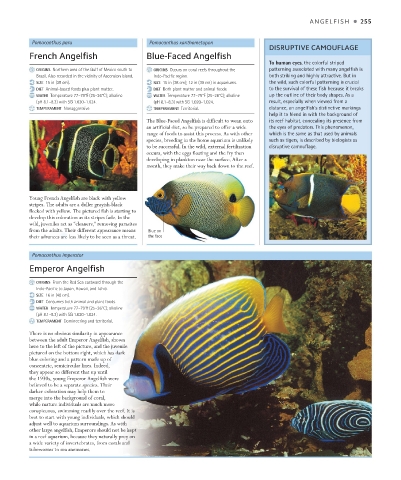
         Young French Angelfish are black with yellow
         stripes. The adults are a duller grayish-black
         flecked with yellow. The pictured fish is starting to
         develop this coloration as its stripes fade. In the
         wild, juveniles act as “cleaners,” removing parasites
         from the adults. Their different appearance means   Blue on
         their advances are less likely to be seen as a threat.     the face

          Pomacanthus imperator
         Emperor Angelfish

           ORIGINS  From the Red Sea eastward through the
           Indo-Pacific to Japan, Hawaii, and Tahiti.
           SIZE  16 in (40 cm).
           DIET  Consumes both animal and plant foods.
           WATER  Temperature 77–79°F (25–26°C); alkaline
           (pH 8.1–8.3) with SG 1.020–1.024.
           TEMPERAMENT  Domineering and territorial.
         There is no obvious similarity in appearance
         between the adult Emperor Angelfish, shown
         here to the left of the picture, and the juvenile
         pictured on the bottom right, which has dark
         blue coloring and a pattern made up of
         concentric, semicircular lines. Indeed,
         they appear so different that up until
         the 1930s, young Emperor Angelfish were
         believed to be a separate species. Their
         darker coloration may help them to
         merge into the background of coral,
         while mature individuals are much more
         conspicuous, swimming readily over the reef. It is
         best to start with young individuals, which should
         adjust well to aquarium surroundings. As with
         other large angelfish, Emperors should not be kept
         in a reef aquarium, because they naturally prey on
         a wide variety of invertebrates, from corals and
         tubeworms to sea anemones.


   US_254-255_Angelfish.indd   255                                                                   29/08/18   4:10 PM

