


Page 267 - Encyclopedia of Aquarium and Pond Fish, 3rd Edition
P. 267
LIONFISH AND SCORPIONFISH    265


          Pterois antennata               Pterois miles
         Spotfin Lionfish                Devil Lionfish                   The fins of this lionfish are very broad and banded
                                                                          along their length, rather than tapering to a point.
           ORIGINS  From East Africa and the Red Sea through the   ORIGINS  Distribution restricted to the vicinity of the    Lionfish are initially reluctant to take inert foods.
           Indo-Pacific to eastern Asia and Australia.   Red Sea and East Africa.  Offering them goldfish as a substitute diet is not
           SIZE  8 in (20 cm).             SIZE  12 in (30 cm).           recommended: quite apart from welfare concerns,
           DIET  Fish-based foods.         DIET  Invertebrates and fish-based foods.    the lionfish are likely to overeat and may die from
           WATER  Temperature 77–79°F (25–26°C); alkaline   WATER  Temperature 77–79°F (25–26°C); alkaline   gut impaction and liver failure. Weaning a lionfish
           (pH 8.0–8.3) with SG 1.021–1.024.   (pH 8.0–8.3) with SG 1.021–1.024.  onto prepared foods can be achieved by using
           TEMPERAMENT  Tends to prey on smaller companions.  TEMPERAMENT  Tolerant of its own kind.  feeding tongs to dangle food near the mouth.
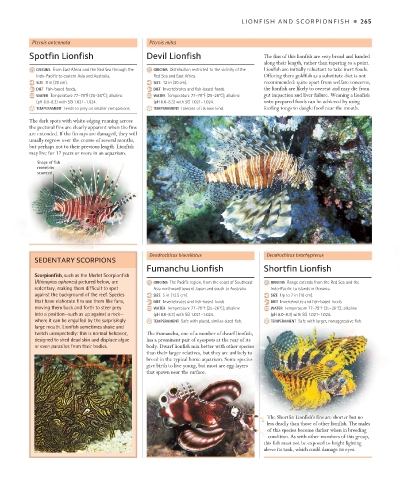
         The dark spots with white edging running across
         the pectoral fins are clearly apparent when the fins
         are extended. If the fin rays are damaged, they will
         usually regrow over the course of several months,
         but perhaps not to their previous length. Lionfish
         may live for 12 years or more in an aquarium.
           Shape of fish
           resembles
           seaweed


                                          Dendrochirus biocellatus        Dendrochirus brachypterus
           SEDENTARY SCORPIONS
                                         Fumanchu Lionfish                Shortfin Lionfish
           Scorpionfish, such as the Merlet Scorpionfish
           (Rhinopias aphanes) pictured below, are   ORIGINS  The Pacific region, from the coast of Southeast   ORIGINS  Range extends from the Red Sea and the
           sedentary, making them difficult to spot   Asia northward toward Japan and south to Australia.  Indo-Pacific to islands in Oceania.
           against the background of the reef. Species   SIZE  5 in (12.5 cm).  SIZE  Up to 7 in (18 cm).
           that have elaborate fins use them like fans,   DIET  Invertebrates and fish-based foods.   DIET  Invertebrates and fish-based foods.
           moving them back and forth to steer prey    WATER  Temperature 77–79°F (25–26°C); alkaline   WATER  Temperature 77–79°F (25–26°C); alkaline
           into a position—such as up against a rock—  (pH 8.0–8.3) with SG 1.021–1.024.  (pH 8.0–8.3) with SG 1.021–1.024.
           where it can be engulfed by the surprisingly   TEMPERAMENT  Safe with placid, similar-sized fish.  TEMPERAMENT  Safe with larger, nonaggressive fish.
           large mouth. Lionfish sometimes shake and
           twitch unexpectedly: this is normal behavior,    The Fumanchu, one of a number of dwarf lionfish,
           designed to shed dead skin and displace algae   has a prominent pair of eyespots at the rear of its
           or even parasites from their bodies.  body. Dwarf lionfish mix better with other species
                                         than their larger relatives, but they are unlikely to
                                         breed in the typical home aquarium. Some species
                                         give birth to live young, but most are egg-layers
                                         that spawn near the surface.


                                                                           The Shortfin Lionfish’s fins are shorter but no
                                                                           less deadly than those of other lionfish. The males
                                                                           of this species become darker when in breeding
                                                                           condition. As with other members of this group,
                                                                          this fish must not be exposed to bright lighting
                                                                          above its tank, which could damage its eyes.


   US_264-265_Dragon_Lionfish.indd   265                                                             29/08/18   4:10 PM

