


Page 268 - Encyclopedia of Aquarium and Pond Fish, 3rd Edition
P. 268
266    MARINE FISH DIRECTORY

         WRASSE


         Wrasse are lively, active fish found in most warm
         seas, though the majority come from tropical
         waters. They tend to be colorful, displaying
         elaborate patterning on their bodies. Their
         shape varies from elongated to deep and
         compressed, and there is a significant range in size
         among members of the group; some of the larger
         species are too big for the home aquarium. They are
         not hard to maintain, feeding readily, but even tame
         specimens can inflict a painful bite if offered food by
         hand. Their fanglike teeth are more usually applied
         to cracking into invertebrates, such as sea urchins,
         which form part of their natural diet.
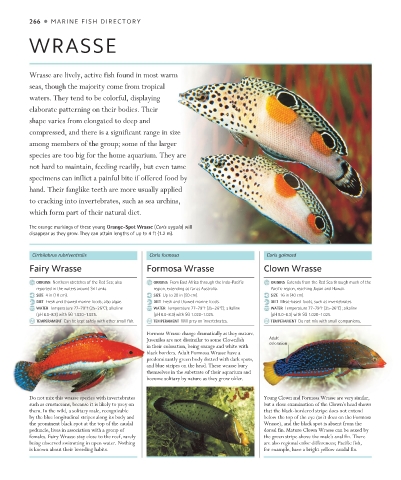
         The orange markings of these young Orange-Spot Wrasse (Coris aygula) will
         disappear as they grow. They can attain lengths of up to 4 ft (1.2 m).

          Cirrhilabrus rubriventralis     Coris formosa                   Coris gaimard
         Fairy Wrasse                    Formosa Wrasse                   Clown Wrasse

           ORIGINS  Northern stretches of the Red Sea; also   ORIGINS  From East Africa through the Indo-Pacific   ORIGINS  Extends from the Red Sea through much of the
           reported in the waters around Sri Lanka.   region, extending as far as Australia.  Pacific region, reaching Japan and Hawaii.
           SIZE  4 in (10 cm).             SIZE  Up to 20 in (50 cm).       SIZE  16 in (40 cm).
           DIET  Fresh and thawed marine foods; also algae.   DIET  Fresh and thawed marine foods.   DIET  Meat-based foods, such as invertebrates.
           WATER  Temperature 77–79°F (25–26°C); alkaline   WATER  Temperature 77–79°F (25–26°C); alkaline   WATER  Temperature 77–79°F (25–26°C); alkaline
           (pH 8.0–8.3) with SG 1.020–1.025.   (pH 8.0–8.3) with SG 1.020–1.025.   (pH 8.0–8.3) with SG 1.020–1.025.
           TEMPERAMENT  Can be kept safely with other small fish.  TEMPERAMENT  Will prey on invertebrates.  TEMPERAMENT  Do not mix with small companions.
                                         Formosa Wrasse change dramatically as they mature.
                                         Juveniles are not dissimilar to some Clownfish    Adult
                                                                           coloration
                                         in their coloration, being orange and white with
                                         black borders. Adult Formosa Wrasse have a
                                         predominantly green body dotted with dark spots,
                                         and blue stripes on the head. These wrasse bury
                                         themselves in the substrate of their aquarium and
                                         become solitary by nature as they grow older.

         Do not mix this wrasse species with invertebrates                Young Clown and Formosa Wrasse are very similar,
         such as crustaceans, because it is likely to prey on             but a close examination of the Clown’s head shows
         them. In the wild, a solitary male, recognizable                 that the black-bordered stripe does not extend
         by the blue longitudinal stripes along its body and              below the top of the eye (as it does on the Formosa
         the prominent black spot at the top of the caudal                Wrasse), and the black spot is absent from the
         peduncle, lives in association with a group of                   dorsal fin. Mature Clown Wrasse can be sexed by
         females. Fairy Wrasse stay close to the reef, rarely             the green stripe above the male’s anal fin. There
         being observed swimming in open water. Nothing                   are also regional color differences; Pacific fish,
         is known about their breeding habits.                            for example, have a bright yellow caudal fin.


   US_266-267_Wrasse_Rainbowfish.indd   266                                                          29/08/18   4:10 PM

