


Page 319 - Encyclopedia of Aquarium and Pond Fish, 3rd Edition
P. 319
FOOD AND FEEDING    317


                                                           TYPES OF FOOD
                                                           Prepared coldwater fish foods contain a
                                                           cereal base, with additional ingredients to
                                                           enhance color, aid digestion, or encourage
                                                           growth. It is important to choose the most
                                                           appropriate foods for all species of fish in
                                                           the pond; for example, make sure there
                                                           is food available that is suitable for    Frozen food tablets are prepackaged
                                                           the smallest species, to ensure that   and should be defrosted before
                                                           no fish will starve.    they are given to the fish.


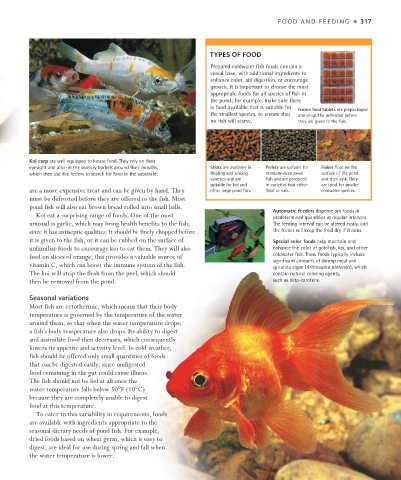
         Koi carp are well equipped to locate food. They rely on their
         eyesight and also on the sensory barbels around their mouths,   Sticks are available in   Pellets are suitable for   Flakes float on the
         which they use like feelers to search for food in the substrate.  floating and sinking   medium-sized pond    surface of the pond
                                                           varieties and are    fish and are produced    and then sink. They
                                                           suitable for koi and    in varieties that either   are ideal for smaller
         are a more expensive treat and can be given by hand. They   other large pond fish.  float or sink.  coldwater species.
         must be defrosted before they are offered to the fish. Most
         pond fish will also eat brown bread rolled into small balls.
           Koi eat a surprising range of foods. One of the most             Automatic feeders dispense dry foods in
                                                                            predetermined quantities at regular intervals.
         unusual is garlic, which may bring health benefits to the fish,    The feeding interval can be altered easily, and
         since it has antiseptic qualities. It should be finely chopped before   the feeder will keep the food dry if it rains.
         it is given to the fish, or it can be rubbed on the surface of     Special color foods help maintain and
         unfamiliar foods to encourage koi to eat them. They will also      enhance the color of goldfish, koi, and other
         feed on slices of orange; this provides a valuable source of       coldwater fish. These foods typically include
         vitamin C, which can boost the immune system of the fish.          significant amounts of shrimp meal and
                                                                            spirulina algae (Arthrospira platensis), which
         The koi will strip the flesh from the peel, which should           contain natural coloring agents,
         then be removed from the pond.                                     such as beta-carotene.
         Seasonal variations
         Most fish are ectothermic, which means that their body
         temperature is governed by the temperature of the water
         around them, so that when the water temperature drops,
         a fish’s body temperature also drops. Its ability to digest
         and assimilate food then decreases, which consequently
         lowers its appetite and activity level. In cold weather,
         fish should be offered only small quantities of foods
         that can be digested easily, since undigested
         food remaining in the gut could cause illness.
         The fish should not be fed at all once the
         water temperature falls below 50°F (10°C)
         because they are completely unable to digest
         food at this temperature.
           To cater to this variability in requirements, foods
         are available with ingredients appropriate to the
         seasonal dietary needs of pond fish. For example,
         dried foods based on wheat germ, which is easy to
         digest, are ideal for use during spring and fall when
         the water temperature is lower.


   US_316-317_Food_Feeding.indd   317                                                                29/08/18   4:11 PM

