


Page 331 - Encyclopedia of Aquarium and Pond Fish, 3rd Edition
P. 331
BREEDING    329


         COMMERCIAL KOI PRODUCTION
         Today, commercial koi breeding practices vary widely from country to   The fry hatch after five days and become free-swimming within a further
         country, but in Japan they still follow fairly traditional lines. A female is   24 hours. They are then moved to a rearing pond. Successful koi breeding
         selected for breeding when she is about five years old. She is kept with   relies on ruthless assessment, and this process begins when the fish are
         two or three males in a large net, on the bottom of which is an artificial   barely a month old. They are carefully caught and examined, and any
         medium known as spawning grass. Using multiple males ensures that as   showing deformities or poor markings are culled, leaving the remaining
         many of her eggs are fertilized as possible. This is vital, since only about   koi more growing space in the pond. Two further culls are carried out
         one in 70,000 fry will be of the highest quality. When the koi have   over the summer. In early fall, the koi are assessed for a final time. The
         spawned, the eggs are moved to a well-oxygenated hatching pond, which   best specimens are kept at the farm as breeding stock and taken indoors
         is medicated to minimize the risk of the eggs being attacked by fungus.   to overwinter, while the remainder of the group are sold.


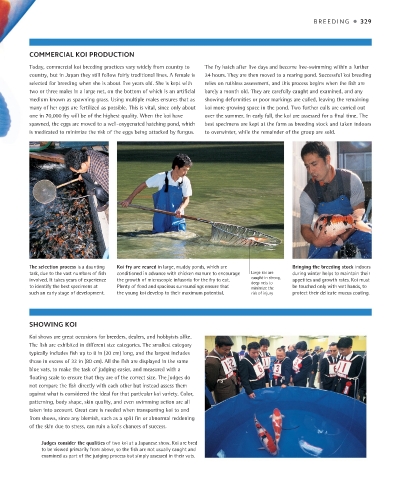
         The selection process is a daunting   Koi fry are reared in large, muddy ponds, which are   Bringing the breeding stock indoors
         task, due to the vast numbers of fish   conditioned in advance with chicken manure to encourage   Large koi are   during winter helps to maintain their
         involved. It takes years of experience   the growth of microscopic infusoria for the fry to eat.   caught in strong,   appetites and growth rates. Koi must
                                                                      deep nets to
         to identify the best specimens at   Plenty of food and spacious surroundings ensure that    minimize the    be touched only with wet hands, to
         such an early stage of development.  the young koi develop to their maximum potential.  risk of injury  protect their delicate mucus coating.


         SHOWING KOI
         Koi shows are great occasions for breeders, dealers, and hobbyists alike.
         The fish are exhibited in different size categories. The smallest category
         typically includes fish up to 8 in (20 cm) long, and the largest includes
         those in excess of 32 in (80 cm). All the fish are displayed in the same
         blue vats, to make the task of judging easier, and measured with a
         floating scale to ensure that they are of the correct size. The judges do
         not compare the fish directly with each other but instead assess them
         against what is considered the ideal for that particular koi variety. Color,
         patterning, body shape, skin quality, and even swimming action are all
         taken into account. Great care is needed when transporting koi to and
         from shows, since any blemish, such as a split fin or abnormal reddening
         of the skin due to stress, can ruin a koi’s chances of success.

            Judges consider the qualities of two koi at a Japanese show. Koi are bred
            to be viewed primarily from above, so the fish are not usually caught and
            examined as part of the judging process but simply assessed in their vats.


   US_328-329_Breeding_Pond_Fish.indd   329                                                          29/08/18   4:11 PM

