


Page 330 - Encyclopedia of Aquarium and Pond Fish, 3rd Edition
P. 330
328    POND FISH: BREEDING

         Breeding


         Left to their own devices, a number of coldwater fish will
         breed readily in a pond environment. However, in a densely
         planted pond, a successful spawning may go unnoticed
         until later in the year, when the fry are larger and can
         be seen feeding alongside the adults. Breeders who
         like to have more control over the reproductive
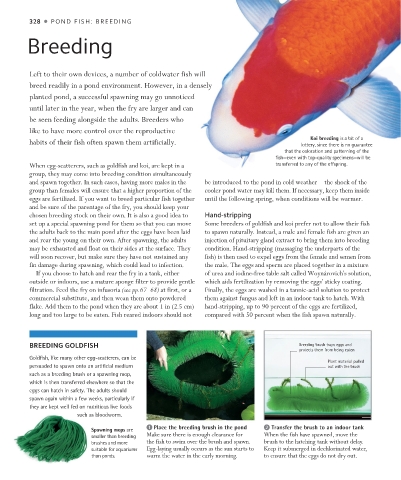
                                                                                       Koi breeding is a bit of a
         habits of their fish often spawn them artificially.                        lottery, since there is no guarantee
                                                                               that the coloration and patterning of the
                                                                             fish—even with top-quality specimens—will be
         When egg-scatterers, such as goldfish and koi, are kept in a        transferred to any of the offspring.
         group, they may come into breeding condition simultaneously
         and spawn together. In such cases, having more males in the   be introduced to the pond in cold weather—the shock of the
         group than females will ensure that a higher proportion of the   cooler pond water may kill them. If necessary, keep them inside
         eggs are fertilized. If you want to breed particular fish together   until the following spring, when conditions will be warmer.
         and be sure of the parentage of the fry, you should keep your
         chosen breeding stock on their own. It is also a good idea to   Hand-stripping
         set up a special spawning pond for them so that you can move   Some breeders of goldfish and koi prefer not to allow their fish
         the adults back to the main pond after the eggs have been laid   to spawn naturally. Instead, a male and female fish are given an
         and rear the young on their own. After spawning, the adults   injection of pituitary gland extract to bring them into breeding
         may be exhausted and float on their sides at the surface. They   condition. Hand-stripping (massaging the underparts of the
         will soon recover, but make sure they have not sustained any   fish) is then used to expel eggs from the female and semen from
         fin damage during spawning, which could lead to infection.  the male. The eggs and sperm are placed together in a mixture
           If you choose to hatch and rear the fry in a tank, either   of urea and iodine-free table salt called Woynárovich’s solution,
         outside or indoors, use a mature sponge filter to provide gentle   which aids fertilization by removing the eggs’ sticky coating.
         filtration. Feed the fry on infusoria (see pp.67–68) at first, or a   Finally, the eggs are washed in a tannic-acid solution to protect
         commercial substitute, and then wean them onto powdered   them against fungus and left in an indoor tank to hatch. With
         flake. Add them to the pond when they are about 1 in (2.5 cm)   hand-stripping, up to 90 percent of the eggs are fertilized,
         long and too large to be eaten. Fish reared indoors should not   compared with 50 percent when the fish spawn naturally.


         BREEDING GOLDFISH                                                         Breeding brush traps eggs and
                                                                                   protects them from being eaten
         Goldfish, like many other egg-scatterers, can be
                                                                                           Plant material pulled
         persuaded to spawn onto an artificial medium                                      out with the brush
         such as a breeding brush or a spawning mop,
         which is then transferred elsewhere so that the
         eggs can hatch in safety. The adults should
         spawn again within a few weeks, particularly if
         they are kept well fed on nutritious live foods
                      such as bloodworm.
                                          1
                                                                          2
                          Spawning mops are    1  Place the breeding brush in the pond   2  Transfer the brush to an indoor tank
                          smaller than breeding   Make sure there is enough clearance for    When the fish have spawned, move the
                          brushes and more   the fish to swim over the brush and spawn.   brush to the hatching tank without delay.
                          suitable for aquariums   Egg-laying usually occurs as the sun starts to   Keep it submerged in dechlorinated water,
                          than ponds.    warm the water in the early morning.  to ensure that the eggs do not dry out.


   US_328-329_Breeding_Pond_Fish.indd   328                                                          29/08/18   4:11 PM

