


Page 329 - Encyclopedia of Aquarium and Pond Fish, 3rd Edition
P. 329
REPRODUCTIVE CYCLE    327

         in Red Shiners they run along the top of the head. In some
         groups, such as sticklebacks, the males become more brightly
         colored to attract mates and deter rivals. In all coldwater   GOLDFISH EGGS AND FRY
         species, the females become fatter-bodied than their male   The incubation period of goldfish eggs and the growth rate of the fry
         counterparts as they swell with eggs prior to spawning.    are both temperature-dependent: generally, the warmer the water, the
         There is also a significant increase in activity in the pond at   more rapidly the young develop. The fry, which measure less than
                                                          ⁄4 in (0.5 mm) long on hatching, are nourished
                                                          1
         this time, as the males chase the females relentlessly, often   at first by their egg sacs. After a few days, they
         butting or nuzzling against them.                are free-swimming and actively seeking food.
         Breeding strategies
         Coldwater pond fish show no long-term pair-bonding; any
         pairings that do occur are purely temporary. Fertilization is                    Goldfish eggs
         external, with eggs and sperm being released into the water                           Embryo
         simultaneously. Most pond species, including goldfish and koi,
         are egg-scatterers. They randomly discharge their sticky eggs,                   Goldfish embryos can
         which either sink to the substrate or attach to the stems and                    be seen curled up inside
         leaves of aquatic plants. Only a small proportion of eggs will be                their eggs in the close-
         fertilized, so the fish compensate by producing large numbers                    up view above. The
                                                                                          eggs usually develop
         of them—up to 400,000 per spawning in the case of koi.                           on oxygenating plants
           After spawning, egg-scatterers have no further involvement                     (left), held in position
         with either their eggs or offspring, but some pond species take                  by their sticky coating.
         more care to ensure that the maximum number of young will
         survive. The Fathead Minnow (see p.360), for example, lays its                    Transparent body
         eggs in caves or under rocky overhangs in order to hide them
         from predators, while male sticklebacks keep a protective                        Newly hatched
                                                                                          goldfish fry hide
         watch over both their eggs and the newly hatched fry.                            among vegetation
                                                                                          for about two months.
         Early life of fry                                                                By the time they
         The reason that coldwater fish spawn in the spring is that this is               emerge, they have
                                                                                          dark-colored bodies
         the time of year when conditions are most favorable for the                      to camouflage them
         survival of the young. The algal bloom that grows in spring, and                 in their murky
         which is often cursed by fishkeepers, is actually crucial to the                 surroundings.
         survival of the fry, since it provides them with their first food.
         The young fish eat not only the algae but also the microscopic
         creatures called infusoria (see pp.67–68) that live among them.
           Dragonfly larvae, water boatmen, and many other
         pond invertebrates—not to mention fish (including
         the fry’s own parents)—will readily prey on
         the young fish. As a result, the fry spend
         most of their early weeks hiding
         among aquatic vegetation,
         rarely straying far from plant
         cover. It can take between
         one and seven years for the
         fish to reach sexual maturity,
         depending on the species and the
         temperature of the water in the pond.
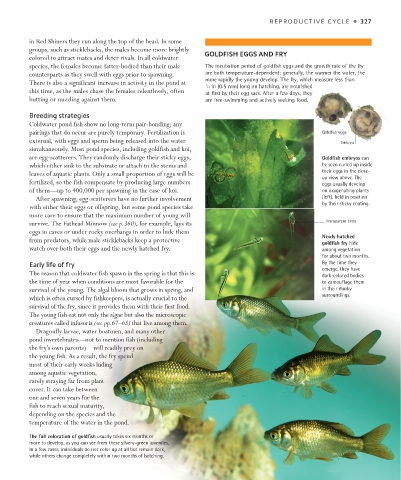
         The full coloration of goldfish usually takes six months or
         more to develop, as you can see from these silvery-green juveniles.
         In a few cases, individuals do not color up at all but remain dark,
         while others change completely within two months of hatching.


   US_326-327_Breeding_cycle.indd   327                                                              29/08/18   4:11 PM

