


Page 328 - Encyclopedia of Aquarium and Pond Fish, 3rd Edition
P. 328
326    POND FISH: BREEDING

         Reproductive cycle


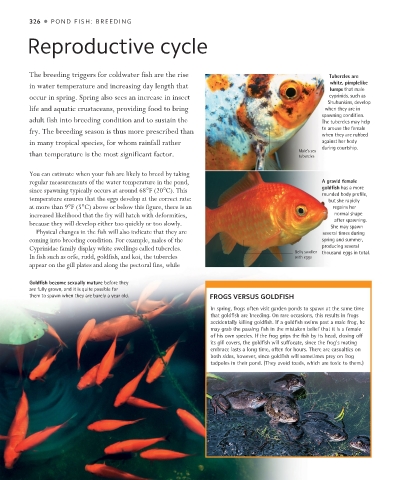
         The breeding triggers for coldwater fish are the rise                              Tubercles are
         in water temperature and increasing day length that                                white, pimplelike
                                                                                            lumps that male
         occur in spring. Spring also sees an increase in insect                            cyprinids, such as
                                                                                           Shubunkins, develop
         life and aquatic crustaceans, providing food to bring                             when they are in
                                                                                          spawning condition.
         adult fish into breeding condition and to sustain the                            The tubercles may help
         fry. The breeding season is thus more prescribed than                            to arouse the female
                                                                                          when they are rubbed
         in many tropical species, for whom rainfall rather                               against her body
         than temperature is the most significant factor.                          Male’s sex   during courtship.
                                                                                   tubercles
         You can estimate when your fish are likely to breed by taking
         regular measurements of the water temperature in the pond,                       A gravid female
         since spawning typically occurs at around 68°F (20°C). This                      goldfish has a more
                                                                                          rounded body profile,
         temperature ensures that the eggs develop at the correct rate:                     but she rapidly
         at more than 9°F (5°C) above or below this figure, there is an                      regains her
         increased likelihood that the fry will hatch with deformities,                      normal shape
                                                                                             after spawning.
         because they will develop either too quickly or too slowly.                        She may spawn
           Physical changes in the fish will also indicate that they are                  several times during
         coming into breeding condition. For example, males of the                        spring and summer,
         Cyprinidae family display white swellings called tubercles.                      producing several
         In fish such as orfe, rudd, goldfish, and koi, the tubercles             Belly swollen   thousand eggs in total.
                                                                                  with eggs
         appear on the gill plates and along the pectoral fins, while

         Goldfish become sexually mature before they
         are fully grown, and it is quite possible for
         them to spawn when they are barely a year old.    FROGS VERSUS GOLDFISH
                                                           In spring, frogs often visit garden ponds to spawn at the same time
                                                           that goldfish are breeding. On rare occasions, this results in frogs
                                                           accidentally killing goldfish. If a goldfish swims past a male frog, he
                                                           may grab the passing fish in the mistaken belief that it is a female
                                                           of his own species. If the frog grips the fish by its head, closing off
                                                           its gill covers, the goldfish will suffocate, since the frog’s mating
                                                           embrace lasts a long time, often for hours. There are casualties on
                                                           both sides, however, since goldfish will sometimes prey on frog
                                                           tadpoles in their pond. (They avoid toads, which are toxic to them.)


   US_326-327_Breeding_cycle.indd   326                                                              29/08/18   4:11 PM

