


Page 335 - Encyclopedia of Aquarium and Pond Fish, 3rd Edition
P. 335
GOLDFISH     333


          Carassius auratus
         Comet
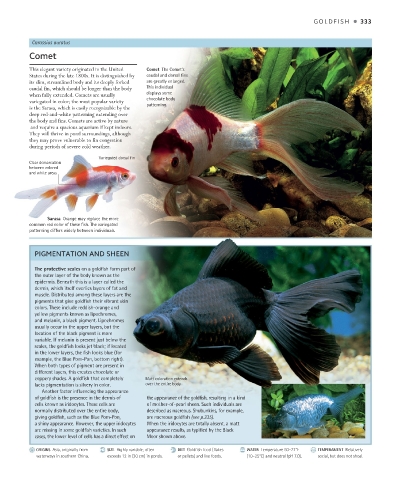
         This elegant variety originated in the United    Comet  The Comet’s
         States during the late 1800s. It is distinguished by   caudal and dorsal fins
         its slim, streamlined body and its deeply forked   are greatly enlarged.
         caudal fin, which should be longer than the body   This individual
         when fully extended. Comets are usually   displays some
         variegated in color; the most popular variety    chocolate body
                                         patterning.
         is the Sarasa, which is easily recognizable by the
         deep red-and-white patterning extending over
         the body and fins. Comets are active by nature
          and require a spacious aquarium if kept indoors.
         They will thrive in pond surroundings, although
         they may prove vulnerable to fin congestion
         during periods of severe cold weather.
                            Variegated dorsal fin
         Clear demarcation
         between colored
         and white areas


              Sarasa  Orange may replace the more
         common red color of these fish. The variegated
         patterning differs widely between individuals.


           PIGMENTATION AND SHEEN

           The protective scales on a goldfish form part of
           the outer layer of the body known as the
           epidermis. Beneath this is a layer called the
           dermis, which itself overlies layers of fat and
           muscle. Distributed among these layers are the
           pigments that give goldfish their vibrant skin
           colors. These include reddish-orange and
           yellow pigments known as lipochromes,
           and melanin, a black pigment. Lipochromes
           usually occur in the upper layers, but the
           location of the black pigment is more
           variable. If melanin is present just below the
           scales, the goldfish looks jet black; if located
           in the lower layers, the fish looks blue (for
           example, the Blue Pom-Pon, bottom right).
           When both types of pigment are present in
           different layers, this creates chocolate or
           coppery shades. A goldfish that completely    Matt coloration extends
           lacks pigmentation is silvery in color.   over the entire body
             Another factor influencing the appearance
           of goldfish is the presence in the dermis of    the appearance of the goldfish, resulting in a kind
           cells known as iridocytes. These cells are    of mother-of-pearl sheen. Such individuals are
           normally distributed over the entire body,    described as nacreous. Shubunkins, for example,
           giving goldfish, such as the Blue Pom-Pon,    are nacreous goldfish (see p.335).
           a shiny appearance. However, the upper iridocytes   When the iridocytes are totally absent, a matt
           are missing in some goldfish varieties. In such   appearance results, as typified by the Black
           cases, the lower level of cells has a direct effect on   Moor shown above.

           ORIGINS  Asia, originally from   SIZE  Highly variable; often   DIET  Goldfish food (flakes    WATER  Temperature 50–77°F   TEMPERAMENT  Relatively
           waterways in southern China.  exceeds 12 in (30 cm) in ponds.  or pellets) and live foods.  (10–25°C) and neutral (pH 7.0).  social, but does not shoal.


   US_332-333_Goldfish_1.indd   333                                                                  29/08/18   4:11 PM

