


Page 337 - Encyclopedia of Aquarium and Pond Fish, 3rd Edition
P. 337
GOLDFISH     335


          Carassius auratus
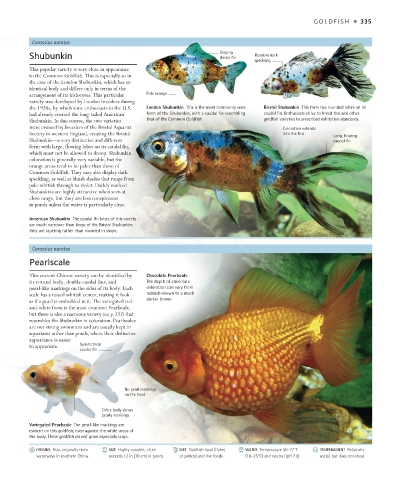
         Shubunkin                                            Sloping   Random dark
                                                              dorsal fin
                                                                       speckling
         This popular variety is very close in appearance
         to the Common Goldfish. This is especially so in
         the case of the London Shubunkin, which has an
         identical body and differs only in terms of the
         arrangement of its iridocytes. This particular   Pale orange
         variety was developed by London breeders during
         the 1920s, by which time enthusiasts in the U.S.   London Shubunkin  This is the most commonly seen   Bristol Shubunkin  This form has rounded lobes on its
         had already created the long-tailed American   form of the Shubunkin, with a caudal fin resembling   caudal fin. Enthusiasts strive to breed this and other
         Shubunkin. In due course, the two varieties    that of the Common Goldfish.  goldfish varieties to prescribed exhibition standards.
         were crossed by breeders of the Bristol Aquarist                      Coloration extends
         Society in western England, creating the Bristol                      into the fins  Long, flowing
         Shubunkin—a very distinctive and different                                          caudal fin
         form with large, flowing lobes on its caudal fin,
         which must not be allowed to droop. Shubunkin
         coloration is generally very variable, but the
         orange areas tend to be paler than those of
         Common Goldfish. They may also display dark
         speckling, as well as bluish shades that range from
         pale-whitish through to violet. Darkly marked
         Shubunkins are highly attractive when seen at
         close range, but they are less conspicuous
         in ponds unless the water is particularly clear.
         American Shubunkin  The caudal fin lobes of this variety
         are much narrower than those of the Bristol Shubunkin;
         they are tapering rather than rounded in shape.

          Carassius auratus
         Pearlscale

         This ancient Chinese variety can be identified by   Chocolate Pearlscale
         its rotund body, double caudal fins, and   The depth of chocolate
         pearl-like markings on the sides of its body. Each   coloration can vary from
         scale has a raised whitish center, making it look    reddish-brown to a much
         as if a pearl is embedded in it. The variegated red-   darker brown.
         and-white form is the most common Pearlscale,
         but there is also a nacreous variety (see p.333) that
         resembles the Shubunkin in coloration. Pearlscales
         are not strong swimmers and are usually kept in
         aquariums rather than ponds, where their distinctive
         appearance is easier
         to appreciate.  Symmetrical
                       caudal fin


                                   No pearl markings
                                   on the head

                             Entire body shows
                             pearly markings
         Variegated Pearlscale  The pearl-like markings are
         evident on this goldfish, even against the white areas of
         the body. These goldfish do not grow especially large.
           ORIGINS  Asia, originally from   SIZE  Highly variable; often   DIET  Goldfish food (flakes    WATER  Temperature 50–77°F   TEMPERAMENT  Relatively
           waterways in southern China.  exceeds 12 in (30 cm) in ponds.  or pellets) and live foods.  (10–25°C) and neutral (pH 7.0).  social, but does not shoal.


   US_334-335_Goldfish_2.indd   335                                                                  29/08/18   4:11 PM

