


Page 340 - Encyclopedia of Aquarium and Pond Fish, 3rd Edition
P. 340
338    POND FISH DIRECTORY


          Carassius auratus
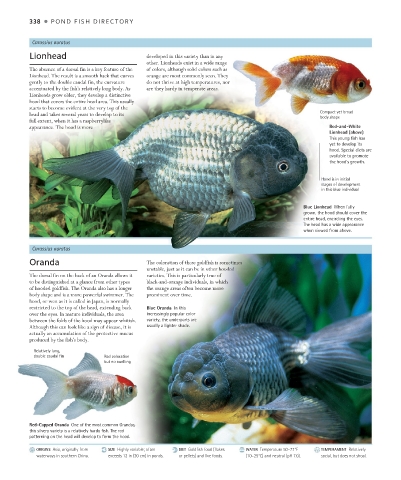
         Lionhead                        developed in this variety than in any
                                         other. Lionheads exist in a wide range
         The absence of a dorsal fin is a key feature of the   of colors, although solid colors such as
         Lionhead. The result is a smooth back that curves   orange are most commonly seen. They
         gently to the double caudal fin, the curvature   do not thrive at high temperatures, nor
         accentuated by the fish’s relatively long body. As   are they hardy in temperate areas.
         Lionheads grow older, they develop a distinctive
         hood that covers the entire head area. This usually
         starts to become evident at the very top of the
         head and takes several years to develop to its                                  Compact yet broad
                                                                                         body shape
         full extent, when it has a raspberrylike
         appearance. The hood is more                                                       Red-and-White
                                                                                            Lionhead (above)
                                                                                            This young fish has
                                                                                            yet to develop its
                                                                                            hood. Special diets are
                                                                                            available to promote
                                                                                            the hood’s growth.
                                                                                          Hood is in initial
                                                                                          stages of development
                                                                                          in this blue individual

                                                                                     Blue Lionhead  When fully
                                                                                     grown, the hood should cover the
                                                                                     entire head, encircling the eyes.
                                                                                     The head has a wide appearance
                                                                                     when viewed from above.

          Carassius auratus
         Oranda                          The coloration of these goldfish is sometimes
                                         unstable, just as it can be in other hooded
         The dorsal fin on the back of an Oranda allows it   varieties. This is particularly true of
         to be distinguished at a glance from other types    black-and-orange individuals, in which
         of hooded goldfish. The Oranda also has a longer   the orange areas often become more
         body shape and is a more powerful swimmer. The   prominent over time.
         hood, or wen as it is called in Japan, is normally
         restricted to the top of the head, extending back   Blue Oranda  In this
         over the eyes. In mature individuals, the area   increasingly popular color
         between the folds of the hood may appear whitish.   variety, the underparts are
         Although this can look like a sign of disease, it is   usually a lighter shade.
         actually an accumulation of the protective mucus
         produced by the fish’s body.
          Relatively long,
          double caudal fin   Red coloration
                              but no swelling


         Red-Capped Oranda  One of the most common Orandas,
         this silvery variety is a relatively hardy fish. The red
         patterning on the head will develop to form the hood.
           ORIGINS  Asia, originally from   SIZE  Highly variable; often   DIET  Goldfish food (flakes    WATER  Temperature 50–77°F   TEMPERAMENT  Relatively
           waterways in southern China.  exceeds 12 in (30 cm) in ponds.  or pellets) and live foods.  (10–25°C) and neutral (pH 7.0).  social, but does not shoal.


   US_338-339_Goldfish_4.indd   338                                                                  29/08/18   4:11 PM

