


Page 341 - Encyclopedia of Aquarium and Pond Fish, 3rd Edition
P. 341
GOLDFISH     339


          Carassius auratus
         Ranchu
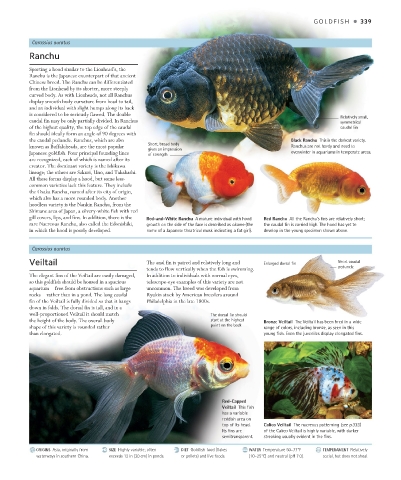
         Sporting a hood similar to the Lionhead’s, the
         Ranchu is the Japanese counterpart of that ancient
         Chinese breed. The Ranchu can be differentiated
         from the Lionhead by its shorter, more steeply
         curved body. As with Lionheads, not all Ranchus
         display smooth body curvature from head to tail,
         and an individual with slight humps along its back
         is considered to be seriously flawed. The double                                      Relatively small,
         caudal fin may be only partially divided. In Ranchus                                  symmetrical
         of the highest quality, the top edge of the caudal                                    caudal fin
         fin should ideally form an angle of 90 degrees with
         the caudal peduncle. Ranchus, which are also                            Black Ranchu  This is the darkest variety.
         known as Buffaloheads, are the most popular   Short, broad body         Ranchus are not hardy and need to
                                          gives an impression
         Japanese goldfish. Four principal founding lines    of strength         overwinter in aquariums in temperate areas.
         are recognized, each of which is named after its
         creator. The dominant variety is the Ishikawa
         lineage; the others are Sakuri, Uno, and Takahashi.
         All these forms display a hood, but some less-
         common varieties lack this feature. They include
         the Osaka Ranchu, named after its city of origin,
         which also has a more rounded body. Another
         hoodless variety is the Nankin Ranchu, from the
         Shimane area of Japan, a silvery-white fish with red
         gill covers, lips, and fins. In addition, there is the   Red-and-White Ranchu  A mature individual with hood   Red Ranchu  All the Ranchu’s fins are relatively short;
         rare Nacreous Ranchu, also called the Edonishiki,   growth on the side of the face is described as okame (the   the caudal fin is carried high. The hood has yet to
         in which the hood is poorly developed.  name of a Japanese theatrical mask indicating a fat girl).  develop in the young specimen shown above.

          Carassius auratus
         Veiltail                        The anal fin is paired and relatively long and    Enlarged dorsal fin  Short caudal
                                         tends to flow vertically when the fish is swimming.   peduncle
         The elegant fins of the Veiltail are easily damaged,   In addition to individuals with normal eyes,
         so this goldfish should be housed in a spacious   telescope-eye examples of this variety are not
         aquarium—free from obstructions such as large   uncommon. The breed was developed from
         rocks—rather than in a pond. The long caudal    Ryukin stock by American breeders around
         fin of the Veiltail is fully divided so that it hangs   Philadelphia in the late 1800s.
         down in folds. The dorsal fin is tall, and in a
         well-proportioned Veiltail it should match        The dorsal fin should
         the height of the body. The overall body          start at the highest   Bronze Veiltail  The Veiltail has been bred in a wide
         shape of this variety is rounded rather           point on the back  range of colors, including bronze, as seen in this
         than elongated.                                                  young fish. Even the juveniles display elongated fins.


                                                              Red-Capped
                                                              Veiltail  This fish
                                                              has a variable
                                                              reddish area on
                                                              top of its head.   Calico Veiltail  The nacreous patterning (see p.333)
                                                              Its fins are   of the Calico Veiltail is highly variable, with darker
                                                              semitransparent.  streaking usually evident in the fins.
           ORIGINS  Asia, originally from   SIZE  Highly variable; often   DIET  Goldfish food (flakes    WATER  Temperature 50–77°F   TEMPERAMENT  Relatively
           waterways in southern China.  exceeds 12 in (30 cm) in ponds.  or pellets) and live foods.  (10–25°C) and neutral (pH 7.0).  social, but does not shoal.


   US_338-339_Goldfish_4.indd   339                                                                  29/08/18   4:11 PM

