


Page 350 - Encyclopedia of Aquarium and Pond Fish, 3rd Edition
P. 350
348    POND FISH DIRECTORY


          Cyprinus carpio
         Sanke
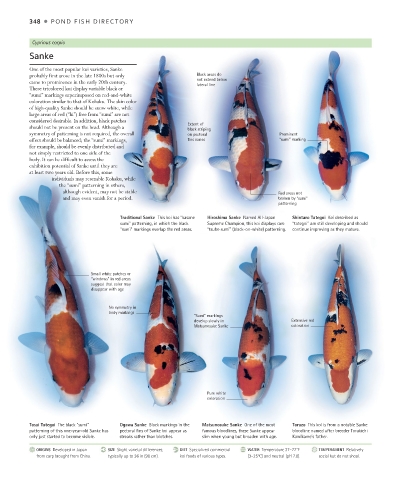
         One of the most popular koi varieties, Sanke
         probably first arose in the late 1800s but only    Black areas do
         came to prominence in the early 20th century.   not extend below
                                                       lateral line
         These tricolored koi display variable black or
         “sumi” markings superimposed on red-and-white
         coloration similar to that of Kohaku. The skin color
         of high-quality Sanke should be snow white, while
         large areas of red (“hi”) free from “sumi” are not
         considered desirable. In addition, black patches
         should not be present on the head. Although a   Extent of
                                                     black striping
         symmetry of patterning is not required, the overall   on pectoral    Prominent
         effect should be balanced; the “sumi” markings,    fins varies       “sumi” marking
         for example, should be evenly distributed and
         not simply restricted to one side of the
         body. It can be difficult to assess the
         exhibition potential of Sanke until they are
         at least two years old. Before this, some
               individuals may resemble Kohaku, while
                 the “sumi” patterning in others,
                  although evident, may not be stable                         Red areas not
                  and may even vanish for a period.                           broken by “sumi”
                                                                              patterning
                                  Traditional Sanke  This koi has “kasane   Hiroshima Sanke  Named All-Japan   Shintaro Tategoi  Koi described as
                                  sumi” patterning, in which the black   Supreme Champion, this koi displays rare   “tategoi” are still developing and should
                                  “sumi” markings overlap the red areas.  “tsubo sumi” (black-on-white) patterning.  continue improving as they mature.


                          Small white patches or
                          “windows” in red areas
                          suggest that color may
                          disappear with age
                               No symmetry in
                               body markings
                                                       “Sumi” markings
                                                       develop slowly in         Extensive red
                                                       Matsunosuke Sanke         coloration


                                                          Pure white
                                                          coloration


         Tosai Tategoi  The black “sumi”   Ogawa Sanke  Black markings in the   Matsunosuke Sanke  One of the most   Torazo  This koi is from a notable Sanke
         patterning of this one-year-old Sanke has   pectoral fins of Sanke koi appear as   famous bloodlines, these Sanke appear   bloodline named after breeder Torakichi
         only just started to become visible.  streaks rather than blotches.  slim when young but broaden with age.  Kawikame’s father.
           ORIGINS  Developed in Japan   SIZE  Slight varietal differences;   DIET  Specialized commercial   WATER  Temperature 37–77°F   TEMPERAMENT  Relatively
           from carp brought from China.  typically up to 36 in (90 cm).  koi foods of various types.  (3–25°C) and neutral (pH 7.0).  social but do not shoal.


   US_348-349_Koi_2.indd   348                                                                       29/08/18   4:11 PM

