


Page 347 - Encyclopedia of Aquarium and Pond Fish, 3rd Edition
P. 347
KOI    345


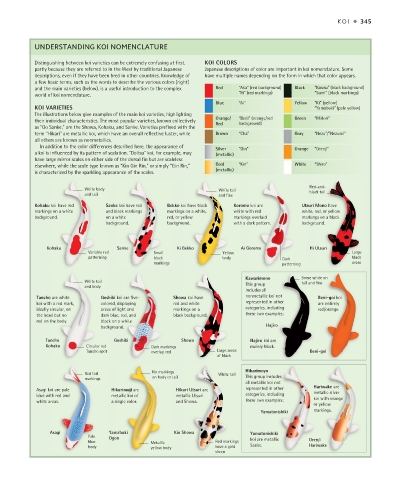
           UNDERSTANDING KOI NOMENCLATURE

           Distinguishing between koi varieties can be extremely confusing at first,    KOI COLORS
           partly because they are referred to in the West by traditional Japanese   Japanese descriptions of color are important in koi nomenclature. Some
           descriptions, even if they have been bred in other countries. Knowledge of    have multiple names depending on the form in which that color appears.
           a few basic terms, such as the words to describe the various colors (right)
           and the main varieties (below), is a useful introduction to the complex    Red  “Aka” (red background)  Black  “Karasu” (black background)
           world of koi nomenclature.                              “Hi” (red markings)  “Sumi” (black markings)
                                                            Blue   “Ai”           Yellow  “Ki” (yellow)
           KOI VARIETIES                                                                “Yamabuki” (pale yellow)
           The illustrations below give examples of the main koi varieties, highlighting
           their individual characteristics. The most popular varieties, known collectively   Orange/  “Beni” (orange/red   Green  “Midori”
                                                                   background)
                                                            Red
           as “Go Sanke,” are the Showa, Kohaku, and Sanke. Varieties prefixed with the
           term “Hikari” are metallic koi, which have an overall reflective luster, while    Brown  “Cha”  Gray  “Nezu”/”Nezumi”
           all others are known as nonmetallics.
             In addition to the color differences described here, the appearance of    Silver   “Gin”  Orange  “Orenji”
           a koi is influenced by its pattern of scalation. “Doitsu” koi, for example, may   (metallic)
           have large mirror scales on either side of the dorsal fin but are scaleless
           elsewhere, while the scale type known as “Kin Gin Rin,” or simply “Gin Rin,”    Gold   “Kin”  White  “Shiro”
           is characterized by the sparkling appearance of the scales.  (metallic)
                                                                                      Red-and-
                        White body                           White tail
                        and tail                             and fins                 black tail
           Kohaku koi have red   Sanke koi have red   Bekko koi have black   Koromo koi are   Utsuri Mono have
           markings on a white   and black markings   markings on a white,   white with red   white, red, or yellow
           background.        on a white       red, or yellow    markings overlaid   markings on a black
                              background.      background.       with a dark pattern.  background.


              Kohaku             Sanke            Ki Bekko         Ai Goromo          Hi Utsuri
                         Variable red      Small              Yellow                              Large
                         patterning        black              body             Dark               black
                                           markings                            patterning         areas
                                                                     Kawarimono     Some white on
                        White tail                                                  tail and fins
                        and body                                     This group
                                                                     includes all
           Tancho are white    Goshiki koi are five-   Showa koi have   nonmetallic koi not   Beni-goi koi
           koi with a red mark,   colored, displaying   red and white   represented in other   are entirely
           ideally circular, on   areas of light and    markings on a   categories, including   red/orange.
           the head but no    dark blue, red, and   black background.  these two examples:
           red on the body.  black on a white
                             background.                                  Hajiro
              Tancho            Goshiki            Showa              Hajiro koi are
              Kohaku     Circular red      Dark markings              mainly black.
                         Tancho spot       overlap red       Large areas              Beni-goi
                                                             of black

                        Red tail           No markings       White tail  Hikarimoyo
                        markings           on body or tail           This group includes
                                                                     all metallic koi not
           Asagi koi are pale   Hikarimuji are    Hikari Utsuri are   represented in other   Hariwake are
                                                                                       metallic silver
           blue with red and    metallic koi of    metallic Utsuri   categories, including   koi with orange
           white areas.         a single color.  and Showa.          these two examples:  or yellow
                                                                         Yamatonishiki  markings.

               Asagi           Yamabuki          Kin Showa            Yamatonishiki
                         Pale   Ogon
                         blue              Metallic         Red markings   koi are metallic   Orenji
                         body              yellow body      have a gold   Sanke.      Hariwake
                                                            sheen


   US_344-345_Intro_to_Koi.indd   345                                                                29/08/18   4:11 PM

