


Page 348 - Encyclopedia of Aquarium and Pond Fish, 3rd Edition
P. 348
346    POND FISH DIRECTORY


          Cyprinus carpio
         Kohaku
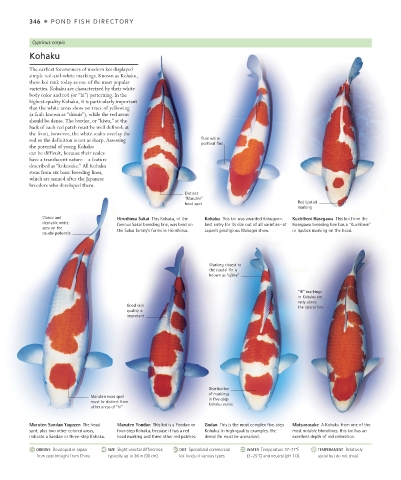
         The earliest forerunners of modern koi displayed
         simple red-and-white markings. Known as Kohaku,
         these koi rank today as one of the most popular
         varieties. Kohaku are characterized by their white
         body color and red (or “hi”) patterning. In the
         highest-quality Kohaku, it is particularly important
         that the white areas show no trace of yellowing
         (a fault known as “shimis”), while the red areas
         should be dense. The border, or “kiwa,” at the
         back of each red patch must be well defined; at
         the front, however, the white scales overlay the
         red so the definition is not as sharp. Assessing   Pure white
                                                        pectoral fins
         the potential of young Kohaku
         can be difficult, because their scales
         have a translucent nature—a feature
         described as “kokesuke.” All Kohaku
         stem from six basic breeding lines,
         which are named after the Japanese
         breeders who developed them.
                                                    Distinct
                                                    “Maruten”
                                                    head spot                      Red lipstick
                                                                                   marking
             Classic and         Hiroshima Sakai  This Kohaku, of the   Kohaku  This koi was awarded Kokugyo—   Kuchibeni Hasegawa  This koi from the
             desirable white     famous Sakai breeding line, was bred on   best entry for its size out of all varieties—at   Hasegawa breeding line has a “Kuchibeni”
             area on the         the Sakai family’s farms in Hiroshima.  Japan’s prestigious Wakagoi show.  or lipstick marking on the head.
             caudal peduncle


                                                           Marking closest to
                                                           the caudal fin is
                                                           known as “ojime”

                                                                                   “Hi” markings
                                                                                   in Kohaku are
                                                                                   only above
                                    Good skin                                      the lateral line
                                    quality is
                                    important


                                                           Distribution
                                                           of markings
                          Maruten head spot                in five-step
                          must be distinct from            Kohaku varies
                          other areas of “hi”

         Maruten Sandan Yagozen  The head   Maruten Yondan  This koi is a Yondan or   Godan  This is the most complex five-step   Matsunosuke  A Kohaku from one of the
         spot, plus two other colored areas,   four-step Kohaku, because it has a red   Kohaku. In high-quality examples, the   most notable bloodlines, this koi has an
         indicate a Sandan or three-step Kohaku.  head marking and three other red patches.  dorsal fin must be unmarked.  excellent depth of red coloration.
           ORIGINS  Developed in Japan   SIZE  Slight varietal differences;   DIET  Specialized commercial   WATER  Temperature 37–77°F   TEMPERAMENT  Relatively
           from carp brought from China.  typically up to 36 in (90 cm).  koi foods of various types.  (3–25°C) and neutral (pH 7.0).  social but do not shoal.


   US_346-347_Koi_1.indd   346                                                                       29/08/18   4:11 PM

