


Page 351 - Encyclopedia of Aquarium and Pond Fish, 3rd Edition
P. 351
KOI    349


          Cyprinus carpio                 Cyprinus carpio                 Cyprinus carpio
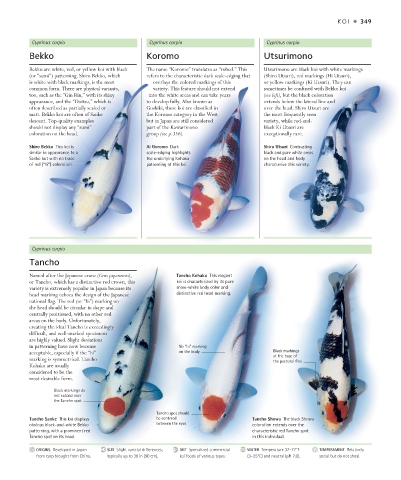
         Bekko                           Koromo                           Utsurimono
         Bekko are white, red, or yellow koi with black    The name “Koromo” translates as “robed.” This   Utsurimono are black koi with white markings
         (or “sumi”) patterning. Shiro Bekko, which    refers to the characteristic dark scale-edging that   (Shiro Utsuri), red markings (Hi Utsuri),
         is white with black markings, is the most   overlays the colored markings of this   or yellow markings (Ki Utsuri). They can
         common form. There are physical variants,   variety. This feature should not extend   sometimes be confused with Bekko koi
         too, such as the “Gin Rin,” with its shiny   into the white areas and can take years   (see left), but the black coloration
         appearance, and the “Doitsu,” which is   to develop fully. Also known as   extends below the lateral line and
         often described as partially scaled or   Goshiki, these koi are classified in   over the head. Shiro Utsuri are
         matt. Bekko koi are often of Sanke   the Koromo category in the West   the most frequently seen
         descent. Top-quality examples   but in Japan are still considered   variety, while red-and-
         should not display any “sumi”   part of the Kawarimono           black Ki Utsuri are
         coloration on the head.         group (see p.356).               exceptionally rare.

         Shiro Bekko  This koi is        Ai Goromo  Dark                  Shiro Utsuri  Contrasting
         similar in appearance to a      scale-edging highlights          black and pure white areas
         Sanke but with no trace         the underlying Kohaku            on the head and body
         of red (“hi”) coloration.       patterning of this koi.          characterize this variety.


          Cyprinus carpio
         Tancho

         Named after the Japanese crane (Grus japonensis),   Tancho Kohaku  This elegant
         or Tancho, which has a distinctive red crown, this   koi is characterized by its pure
         variety is extremely popular in Japan because its   snow-white body color and
         head marking echoes the design of the Japanese   distinctive red head marking.
         national flag. The red (or “hi”) marking on
         the head should be circular in shape and
         centrally positioned, with no other red
         areas on the body. Unfortunately,
         creating the ideal Tancho is exceedingly
         difficult, and well-marked specimens
         are highly valued. Slight deviations
         in patterning have now become            No “hi” marking
         acceptable, especially if the “hi”       on the body               Black markings
                                                                            at the base of
         marking is symmetrical. Tancho                                     the pectoral fins
         Kohaku are usually
         considered to be the
         most desirable form.
                Black markings do
                not extend over
                the Tancho spot
                                            Tancho spot should
         Tancho Sanke  This koi displays    be centered                Tancho Showa  The black Showa
         obvious black-and-white Bekko      between the eyes           coloration extends over the
         patterning, with a prominent red                              characteristic red Tancho spot
         Tancho spot on its head.                                      in this individual.
           ORIGINS  Developed in Japan   SIZE  Slight varietal differences;   DIET  Specialized commercial   WATER  Temperature 37–77°F   TEMPERAMENT  Relatively
           from carp brought from China.  typically up to 36 in (90 cm).  koi foods of various types.  (3–25°C) and neutral (pH 7.0).  social but do not shoal.


   US_348-349_Koi_2.indd   349                                                                       29/08/18   4:11 PM

