


Page 363 - Encyclopedia of Aquarium and Pond Fish, 3rd Edition
P. 363
OTHER COLDWATER FISH    361


          Leuciscus idus
         Orfe

           ORIGINS  Widely distributed through northern Europe,
           although it does not occur naturally in Norway.
           SIZE  24 in (60 cm).
           DIET  Pond foods and live foods.
           WATER  Temperature 32–86°F (0–30°C); hard
           (100–150 mg/l) and neutral to alkaline (pH 7.0–7.5).
           TEMPERAMENT  Social and active by nature.
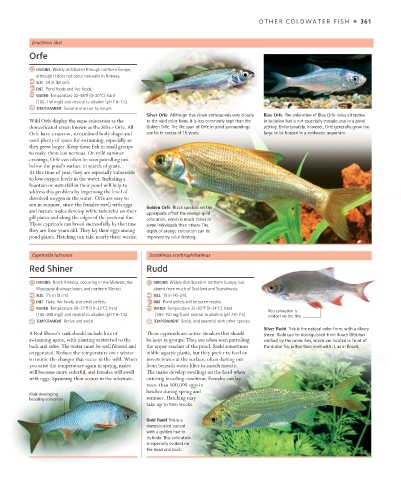
                                         Silver Orfe  Although this strain corresponds very closely   Blue Orfe  The coloration of Blue Orfe looks attractive
         Wild Orfe display the same coloration as the   to the wild color form, it is less commonly kept than the   in isolation but is not especially conspicuous in a pond
         domesticated strain known as the Silver Orfe. All   Golden Orfe. The life span of Orfe in pond surroundings   setting. Unfortunately, however, Orfe generally grow too
         Orfe have a narrow, streamlined body shape and   can be in excess of 15 years.  large to be housed in a coldwater aquarium.
         need plenty of space for swimming, especially as
         they grow larger. Keep these fish in small groups
         to make them less nervous. On mild summer
         evenings, Orfe can often be seen patrolling just
         below the pond’s surface in search of gnats.
         At this time of year, they are especially vulnerable
         to low oxygen levels in the water. Including a
         fountain or waterfall in their pond will help to
         address this problem by improving the level of
         dissolved oxygen in the water. Orfe are easy to
         sex in summer, since the females swell with eggs   Golden Orfe  Black speckles on the
         and mature males develop white tubercles on their    upperparts offset the orange-gold
         gill plates and along the edges of the pectoral fins.   coloration, which is much richer in
         These cyprinids can breed successfully by the time   some individuals than others. The
         they are four years old. They lay their eggs among   depth of orange coloration can be
         pond plants. Hatching can take nearly three weeks.  improved by color feeding.

          Cyprinella lutrensis            Scardinius erythrophthalmus
         Red Shiner                      Rudd

           ORIGINS  North America, occurring in the Midwest, the   ORIGINS  Widely distributed in northern Europe, but
           Mississippi drainage basin, and northern Mexico.  absent from much of Scotland and Scandinavia.
           SIZE  3 ⁄2 in (9 cm).           SIZE  18 in (45 cm).
              1
           DIET  Flake, live foods, and small pellets.  DIET  Pond pellets will be eaten readily.
           WATER  Temperature 50–77°F (10–25°C); hard    WATER  Temperature 32–93°F (0–34°C); hard   Red coloration is
           (100–200 mg/l) and neutral to alkaline (pH 7.0–7.5).   (100–150 mg/l) and neutral to alkaline (pH 7.0–7.5).  evident on the fins
           TEMPERAMENT  Active and social.  TEMPERAMENT  Social, and peaceful with other species.
                                                                          Silver Rudd  This is the natural color form, with a silvery
         A Red Shiner’s tank should include lots of   These cyprinids are active shoalers that should    sheen. Rudd can be distinguished from Roach (Ratilius
         swimming space, with planting restricted to the   be kept in groups. They are often seen patrolling   ratilius) by the pelvic fins, which are located in front of
         back and sides. The water must be well filtered and   the upper reaches of the pond. Rudd sometimes   the dorsal fin, rather than level with it, as in Roach.
         oxygenated. Reduce the temperature over winter   nibble aquatic plants, but they prefer to feed on
         to mimic the changes that occur in the wild. When   invertebrates at the surface, often darting out
         you raise the temperature again in spring, males   from beneath water lilies to snatch insects.
         will become more colorful, and females will swell   The males develop swellings on the head when
         with eggs. Spawning then occurs in the substrate.  entering breeding condition. Females can lay
                                         more than 100,000 eggs in
                                         batches during spring and
         Male developing
         breeding coloration             summer. Hatching may
                                         take up to two weeks.
                                         Gold Rudd This is a
                                         domesticated variant
                                         with a golden hue to
                                         its body. This coloration
                                         is especially evident on
                                         the head and back.


   US_360-361_Other_Coldwater_Fish.indd   361                                                        29/08/18   4:11 PM

