


Page 366 - Encyclopedia of Aquarium and Pond Fish, 3rd Edition
P. 366
364    POND PLANT DIRECTORY

         MARGINAL PLANTS


         These plants are more decorative than
         functional. However, when planted in
         containers on the marginal shelf—the ledge
         around the inside of preformed ponds, about
         12 in (30 cm) below the surface—they can
         provide retreats for young fish. Marginals
         can also be grown as edging plants, giving
         the pond a more informal look and creating
         a barrier that makes it more difficult for predators
         to reach the fish. Some marginals trail down into the
         water, which helps to hide the perimeter from view.
         All the plants featured here are suitable for temperate
         climates, but some will benefit from protection in winter.
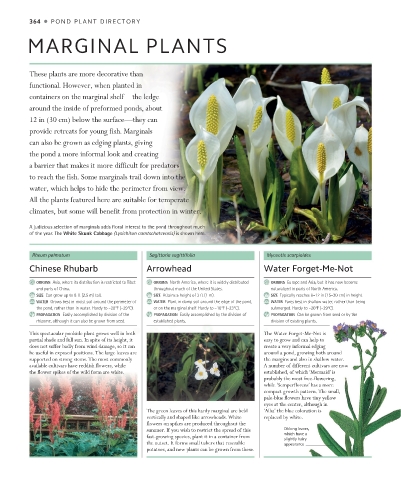
         A judicious selection of marginals adds floral interest to the pond throughout much
         of the year. The White Skunk Cabbage (Lysichiton camtschatcensis) is shown here.

          Rheum palmatum                  Sagittaria sagittifolia         Myosotis scorpioides
         Chinese Rhubarb                 Arrowhead                        Water Forget-Me-Not

           ORIGINS  Asia, where its distribution is restricted to Tibet   ORIGINS  North America, where it is widely distributed   ORIGINS  Europe and Asia, but it has now become
           and parts of China.             throughout much of the United States.  naturalized in parts of North America.
           SIZE  Can grow up to 8 ft (2.5 m) tall.  SIZE  Attains a height of 3 ft (1 m).  SIZE  Typically reaches 6–12 in (15–30 cm) in height.
           WATER  Grows best in moist soil around the perimeter of   WATER  Plant in damp soil around the edge of the pond,   WATER  Fares best in shallow water, rather than being
           the pond, rather than in water. Hardy to –20°F (–29°C).  or on the marginal shelf. Hardy to –10°F (–23°C).  submerged. Hardy to –20°F (–29°C).
           PROPAGATION  Easily accomplished by division of the   PROPAGATION  Easily accomplished by the division of   PROPAGATION  Can be grown from seed or by the
           rhizome, although it can also be grown from seed.  established plants.  division of existing plants.
         This spectacular poolside plant grows well in both               The Water Forget-Me-Not is
         partial shade and full sun. In spite of its height, it           easy to grow and can help to
         does not suffer badly from wind damage, so it can                create a very informal edging
         be useful in exposed positions. The large leaves are             around a pond, growing both around
         supported on strong stems. The most commonly                     the margins and also in shallow water.
         available cultivars have reddish flowers, while                  A number of different cultivars are now
         the flower spikes of the wild form are white.                    established, of which ‘Mermaid’ is
                                                                          probably the most free-flowering,
                                                                          while ‘Semperflorens’ has a more
                                                                          compact growth pattern. The small,
                                                                          pale-blue flowers have tiny yellow
                                                                          eyes at the center, although in
                                         The green leaves of this hardy marginal are held   ‘Alba’ the blue coloration is
                                         vertically and shaped like arrowheads. White   replaced by white.
                                         flowers on spikes are produced throughout the
                                         summer. If you wish to restrict the spread of this   Oblong leaves,
                                         fast-growing species, plant it in a container from   which have a
                                                                               slightly hairy
                                         the outset. It forms small tubers that resemble   appearance
                                         potatoes, and new plants can be grown from these.


   US_364-365_Marginals_1.indd   364                                                                 29/08/18   4:11 PM

