


Page 375 - Encyclopedia of Aquarium and Pond Fish, 3rd Edition
P. 375
FLOATING PLANTS    373


          Lemna species                   Stratiotes aloides              Pistia stratiotes
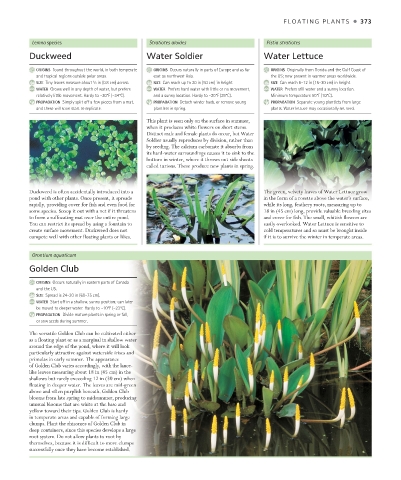
         Duckweed                        Water Soldier                    Water Lettuce

           ORIGINS  Found throughout the world, in both temperate   ORIGINS  Occurs naturally in parts of Europe and as far   ORIGINS  Originally from Florida and the Gulf Coast of
           and tropical regions outside polar areas.  east as northwest Asia.  the US; now present in warmer areas worldwide.
           SIZE  Tiny leaves measure about  ⁄3 in (0.8 cm) across.  SIZE  Can reach up to 20 in (50 cm) in height.  SIZE  Can reach 6–12 in (15–30 cm) in height.
                           1
           WATER  Grows well in any depth of water, but prefers   WATER  Prefers hard water with little or no movement,   WATER  Prefers still water and a sunny location.
           relatively little movement. Hardy to –30°F (–34°C).  and a sunny location. Hardy to –20°F (29°C).  Minimum temperature 50°F (10°C).
           PROPAGATION  Simply split off a few pieces from a mat,   PROPAGATION  Detach winter buds, or remove young   PROPAGATION  Separate young plantlets from large
           and these will soon start to replicate.  plantlets in spring.    plants. Water lettuce may occasionally set seed.
                                         This plant is seen only on the surface in summer,
                                         when it produces white flowers on short stems.
                                         Distinct male and female plants do occur, but Water
                                         Soldier usually reproduces by division, rather than
                                         by seeding. The calcium carbonate it absorbs from
                                         its hard-water surroundings causes it to sink to the
                                         bottom in winter, where it throws out side shoots
                                         called turions. These produce new plants in spring.


         Duckweed is often accidentally introduced into a                 The green, velvety leaves of Water Lettuce grow
         pond with other plants. Once present, it spreads                 in the form of a rosette above the water’s surface,
         rapidly, providing cover for fish and even food for              while its long, feathery roots, measuring up to
         some species. Scoop it out with a net if it threatens            18 in (45 cm) long, provide valuable breeding sites
         to form a suffocating mat over the entire pond.                  and cover for fish. The small, whitish flowers are
         You can restrict its spread by using a fountain to               easily overlooked. Water Lettuce is sensitive to
         create surface movement. Duckweed does not                       cold temperatures and so must be brought inside
         compete well with other floating plants or lilies.               if it is to survive the winter in temperate areas.

          Orontium aquaticum
         Golden Club

           ORIGINS  Occurs naturally in eastern parts of Canada
           and the US.
           SIZE  Spread is 24–30 in (60 –75 cm).
           WATER  Start off in a shallow, sunny position; can later
           be moved to deeper water. Hardy to –10°F (–23°C).
           PROPAGATION  Divide mature plants in spring or fall,
           or sow seeds during summer.
         The versatile Golden Club can be cultivated either
         as a floating plant or as a marginal in shallow water
         around the edge of the pond, where it will look
         particularly attractive against waterside irises and
         primulas in early summer. The appearance
         of Golden Club varies accordingly, with the lance-
         like leaves measuring about 18 in (45 cm) in the
         shallows but rarely exceeding 12 in (30 cm) when
         floating in deeper water. The leaves are mid-green
         above and often purplish beneath. Golden Club
         blooms from late spring to midsummer, producing
         unusual blooms that are white at the base and
         yellow toward their tips. Golden Club is hardy
         in temperate areas and capable of forming large
         clumps. Plant the rhizomes of Golden Club in
         deep containers, since this species develops a large
         root system. Do not allow plants to root by
         themselves, because it is difficult to move clumps
         successfully once they have become established.


   US_372-373_Floating_Plants.indd   373                                                             29/08/18   4:11 PM

