


Page 145 - (DK) Help Your Kids with Growing Up: A No-Nonsense Guide to Puberty and Adolescence
P. 145
PRIV A CY    143

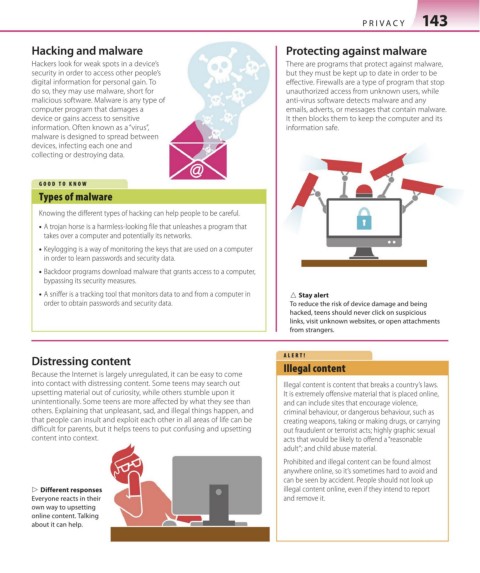
        Hacking and malware                                        Protecting against malware
        Hackers look for weak spots in a device’s                  There are programs that protect against malware,
        security in order to access other people’s                 but they must be kept up to date in order to be
        digital information for personal gain. To                  effective. Firewalls are a type of program that stop
        do so, they may use malware, short for                     unauthorized access from unknown users, while
        malicious software. Malware is any type of                 anti-virus software detects malware and any
        computer program that damages a                            emails, adverts, or messages that contain malware.
        device or gains access to sensitive                        It then blocks them to keep the computer and its
        information. Often known as a “virus”,                     information safe.
        malware is designed to spread between
        devices, infecting each one and
        collecting or destroying data.


          GOOD  T O  KNO W
          Types of malware

          Knowing the different types of hacking can help people to be careful.
          • A trojan horse is a harmless-looking file that unleashes a program that
           takes over a computer and potentially its networks.
          • Keylogging is a way of monitoring the keys that are used on a computer
           in order to learn passwords and security data.
          • Backdoor programs download malware that grants access to a computer,
           bypassing its security measures.
          • A sniffer is a tracking tool that monitors data to and from a computer in   △ Stay alert
           order to obtain passwords and security data.             To reduce the risk of device damage and being
                                                                    hacked, teens should never click on suspicious
                                                                    links, visit unknown websites, or open attachments
                                                                    from strangers.


        Distressing content                                       ALERT !
        Because the Internet is largely unregulated, it can be easy to come    Illegal content
        into contact with distressing content. Some teens may search out   Illegal content is content that breaks a country’s laws.
        upsetting material out of curiosity, while others stumble upon it   It is extremely offensive material that is placed online,
        unintentionally. Some teens are more affected by what they see than   and can include sites that encourage violence,
        others. Explaining that unpleasant, sad, and illegal things happen, and   criminal behaviour, or dangerous behaviour, such as
        that people can insult and exploit each other in all areas of life can be   creating weapons, taking or making drugs, or carrying
        difficult for parents, but it helps teens to put confusing and upsetting   out fraudulent or terrorist acts; highly graphic sexual
        content into context.                                     acts that would be likely to offend a “reasonable
                                                                  adult”; and child abuse material.
                                                                  Prohibited and illegal content can be found almost
                                                                  anywhere online, so it’s sometimes hard to avoid and
                                                                  can be seen by accident. People should not look up
        ▷ Different responses                                     illegal content online, even if they intend to report
        Everyone reacts in their                                  and remove it.
        own way to upsetting
        online content. Talking
        about it can help.


   142-143_Privacy.indd   143                                                                        24/03/2017   17:18

