


Page 70 - (DK) Help Your Kids with Growing Up: A No-Nonsense Guide to Puberty and Adolescence
P. 70
68        HEALTH Y  BOD Y


        Healthy eating                                                     SEE ALSO               70–71   ›

                                                                           Eating disorders
                                                                           Body image             72–73   ›
        During puberty, the teen body needs extra energy and nutrients     Exercise               74–75   ›
        to support all the changes it’s going through. Developing good     Exams and revision   104–105   ›
        eating habits during adolescence can make living a healthy life
        easier, as these habits often stick into adulthood.


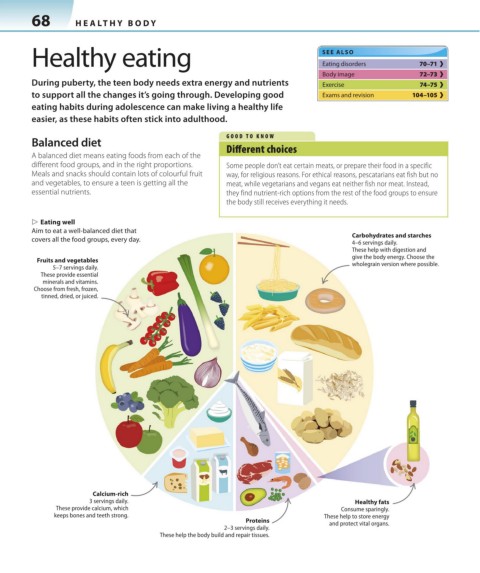
        Balanced diet                                GOOD  T O  KNO W
                                                     Different choices
        A balanced diet means eating foods from each of the
        different food groups, and in the right proportions.   Some people don’t eat certain meats, or prepare their food in a specific
        Meals and snacks should contain lots of colourful fruit   way, for religious reasons. For ethical reasons, pescatarians eat fish but no
        and vegetables, to ensure a teen is getting all the   meat, while vegetarians and vegans eat neither fish nor meat. Instead,
        essential nutrients.                         they find nutrient-rich options from the rest of the food groups to ensure
                                                     the body still receives everything it needs.

        ▷ Eating well
        Aim to eat a well-balanced diet that
        covers all the food groups, every day.                                    Carbohydrates and starches
                                                                                  4–6 servings daily.
                                                                                  These help with digestion and
                                                                                  give the body energy. Choose the
         Fruits and vegetables
             5–7 servings daily.                                                  wholegrain version where possible.
          These provide essential
           minerals and vitamins.
         Choose from fresh, frozen,
          tinned, dried, or juiced.


                      Calcium-rich
                      3 servings daily.                                            Healthy fats
              These provide calcium, which                                      Consume sparingly.
             keeps bones and teeth strong.                                  These help to store energy
                                                          Proteins           and protect vital organs.
                                                     2–3 servings daily.
                                      These help the body build and repair tissues.


   068-069_Healthy_eating.indd   68                                                                  24/03/2017   17:16

