


Page 72 - (DK) Help Your Kids with Growing Up: A No-Nonsense Guide to Puberty and Adolescence
P. 72
70        HEALTH Y  BOD Y


        Eating disorders                                                   SEE ALSO
                                                                           ‹
                                                                            68–69  Healthy eating
                                                                           Body image             72–73   ›
        If someone has abnormal, unhealthy, or even dangerous eating       Confidence and self-esteem   86–87   ›
        habits, they might have a condition known as an eating disorder.   Anxiety and depression   94–95   ›
        These affect people regardless of their gender, race, or background.

        Relationships with eating
        Eating enables people to stay physically and
        mentally well, and mealtimes allow for bonding
        and socializing with family and friends. But when
        a person’s relationship with food dominates their
        thinking, or becomes unhealthy or harmful, it’s
        known as an eating disorder.
          Eating disorders occur when a person’s
        relationship with food becomes the source of
        internal pressure or a means of exerting control
        over their situation. They can develop for many
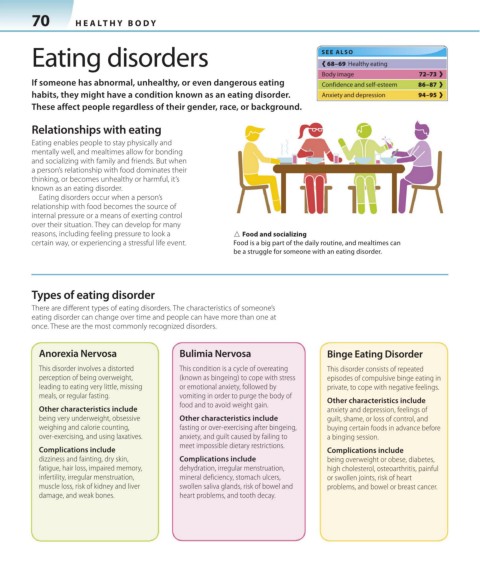
        reasons, including feeling pressure to look a   △ Food and socializing
        certain way, or experiencing a stressful life event.   Food is a big part of the daily routine, and mealtimes can
                                                       be a struggle for someone with an eating disorder.


        Types of eating disorder
        There are different types of eating disorders. The characteristics of someone’s
        eating disorder can change over time and people can have more than one at
        once. These are the most commonly recognized disorders.


          Anorexia Nervosa                Bulimia Nervosa                   Binge Eating Disorder
          This disorder involves a distorted   This condition is a cycle of overeating   This disorder consists of repeated
          perception of being overweight,   (known as bingeing) to cope with stress   episodes of compulsive binge eating in
          leading to eating very little, missing   or emotional anxiety, followed by   private, to cope with negative feelings.
          meals, or regular fasting.      vomiting in order to purge the body of
                                          food and to avoid weight gain.    Other characteristics include
          Other characteristics include                                     anxiety and depression, feelings of
          being very underweight, obsessive   Other characteristics include     guilt, shame, or loss of control, and
          weighing and calorie counting,   fasting or over-exercising after bingeing,   buying certain foods in advance before
          over-exercising, and using laxatives.  anxiety, and guilt caused by failing to   a binging session.
                                          meet impossible dietary restrictions.
          Complications include                                             Complications include
          dizziness and fainting, dry skin,   Complications include         being overweight or obese, diabetes,
          fatigue, hair loss, impaired memory,   dehydration, irregular menstruation,   high cholesterol, osteoarthritis, painful
          infertility, irregular menstruation,   mineral deficiency, stomach ulcers,   or swollen joints, risk of heart
          muscle loss, risk of kidney and liver   swollen saliva glands, risk of bowel and   problems, and bowel or breast cancer.
          damage, and weak bones.         heart problems, and tooth decay.


   070-071_Eating_disorders.indd   70                                                                24/03/2017   17:16

