


Page 73 - (DK) Help Your Kids with Growing Up: A No-Nonsense Guide to Puberty and Adolescence
P. 73
EATING  DISORDERS            71


          Warning signs

          There are some common signs to look out for that may indicate a person
          has an eating disorder:


            • Rapid weight loss, or frequent   • Disordered eating behaviours, such   • Repeated weighing and obsessive
             weight changes                  as eating very little or excessively   calorie counting


            • Refusing to eat with other people    • Saying negative things about    • Feeling tired or with low energy
             or in public                    the body


            • Wearing baggy or oversized   • Extreme exercise habits       • Secretive behaviour or disappearing
             clothing to hide the body                                      to the bathroom after meals


        Seeking help                                              GOOD  T O  KNO W

        The health problems caused by eating disorders can be fatal if left   Helping a loved one
        untreated, so it’s essential to address the issue as soon as possible.   • Stay calm, and avoid passing judgement, blame, or
        Helping a loved one can be a challenge, especially if they are in denial or   criticism. Instead, build their self-esteem with praise.
        act defensively. After seeing a doctor, it may be necessary for them to be
        referred to a specialized eating disorders clinic for further support.  • Try not to be pushy with advice – rather, ask what
                                                                   support they need. Talk to them about how they feel.
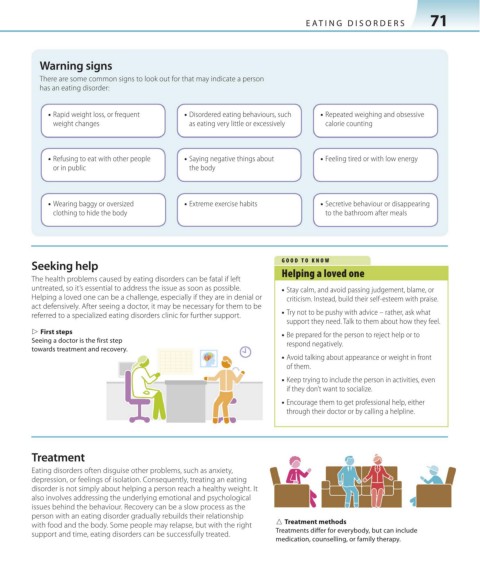
        ▷ First steps                                             • Be prepared for the person to reject help or to
        Seeing a doctor is the first step                          respond negatively.
        towards treatment and recovery.
                                                                  • Avoid talking about appearance or weight in front
                                                                   of them.
                                                                  • Keep trying to include the person in activities, even
                                                                   if they don’t want to socialize.
                                                                  • Encourage them to get professional help, either
                                                                   through their doctor or by calling a helpline.


        Treatment
        Eating disorders often disguise other problems, such as anxiety,
        depression, or feelings of isolation. Consequently, treating an eating
        disorder is not simply about helping a person reach a healthy weight. It
        also involves addressing the underlying emotional and psychological
        issues behind the behaviour. Recovery can be a slow process as the
        person with an eating disorder gradually rebuilds their relationship
        with food and the body. Some people may relapse, but with the right   △ Treatment methods
        support and time, eating disorders can be successfully treated.  Treatments differ for everybody, but can include
                                                                 medication, counselling, or family therapy.


   070-071_Eating_disorders.indd   71                                                                24/03/2017   17:16

