


Page 152 - Atlas Of The World's Strangest Animals
P. 152
152      ATLAS  OF THE WORLD’S  STRANGEST ANIMALS


                                                                  found in huge numbers. No wonder then, that so many
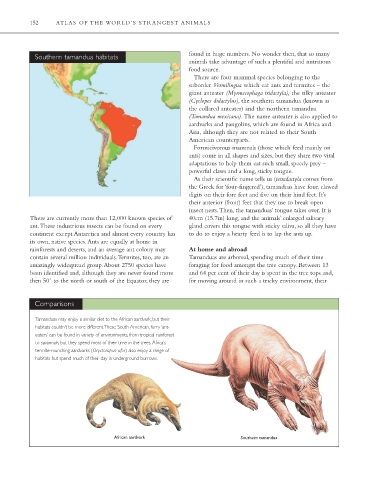
             Southern tamandua habitats
                                                                  animals take advantage of such a plentiful and nutritious
                                                                  food source.
                                                                    There are four mammal species belonging to the
                                                                  suborder Vermilingua which eat ants and termites – the
                                                                  giant anteater (Myrmecophaga tridactyla), the silky anteater
                                                                  (Cyclopes didactylus), the southern tamandua (known as
                                                                  the collared anteater) and the northern tamandua
                                                                  (Tamandua mexicana). The name anteater is also applied to
                                                                  aardvarks and pangolins, which are found in Africa and
                                                                  Asia, although they are not related to their South
                                                                  American counterparts.
                                                                    Formicivorous mammals (those which feed mainly on
                                                                  ants) come in all shapes and sizes, but they share two vital
                                                                  adaptations to help them eat such small, speedy prey –
                                                                  powerful claws and a long, sticky tongue.
                                                                    As their scientific name tells us (tetradactyla comes from
                                                                  the Greek for ‘four-fingered’), tamanduas have four, clawed
                                                                  digits on their fore feet and five on their hind feet. It’s
                                                                  their anterior (front) feet that they use to break open
                                                                  insect nests.Then, the tamanduas’ tongue takes over. It is
           There are currently more than 12,000 known species of  40cm (15.7in) long, and the animals’ enlarged salivary
           ant.These industrious insects can be found on every    gland covers this tongue with sticky saliva, so all they have
           continent except Antarctica and almost every country has  to do to enjoy a hearty feed is to lap the ants up.
           its own, native species.Ants are equally at home in
           rainforests and deserts, and an average ant colony may  At home and abroad
           contain several million individuals.Termites, too, are an  Tamanduas are arboreal, spending much of their time
           amazingly widespread group.About 2750 species have     foraging for food amongst the tree canopy. Between 13
           been identified and, although they are never found more  and 64 per cent of their day is spent in the tree tops and,
           then 50˚ to the north or south of the Equator, they are  for moving around in such a tricky environment, their


             Comparisons

             Tamanduas may enjoy a similar diet to the African aardvark, but their
             habitats couldn’t be more different.These South American, furry ‘ant-
             eaters’ can be found in variety of environments, from tropical rainforest
             to savannah, but they spend most of their time in the trees.Africa’s
             termite-munching aardvarks (Orycterapus afer) also enjoy a range of
             habitats but spend much of their day in underground burrows.


                                        African aardvark                            Southern tamandua


                                             (c) 2011 Marshall Cavendish. All Rights Reserved.

