


Page 153 - Atlas Of The World's Strangest Animals
P. 153
SOUTHERN TAMANDUA                153


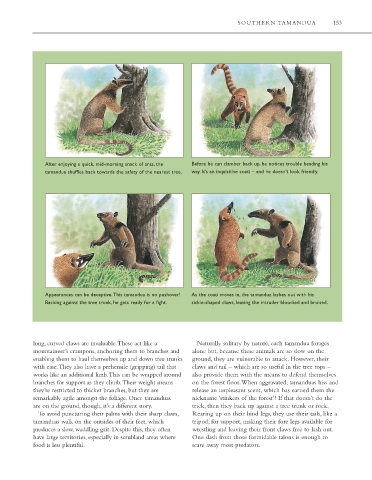
                 After enjoying a quick, mid-morning snack of ants, the  Before he can clamber back up, he notices trouble heading his
                 tamandua shuffles back towards the safety of the nearest tree.  way. It’s an inquisitive coati – and he doesn’t look friendly.


                 Appearances can be deceptive.This tamandua is no pushover!  As the coati moves in, the tamandua lashes out with his
                 Backing against the tree trunk, he gets ready for a fight.  sickle-shaped claws, leaving the intruder bloodied and bruised.


             long, curved claws are invaluable.These act like a      Naturally solitary by nature, each tamandua forages
             mountaineer’s crampons, anchoring them to branches and  alone but, because these animals are so slow on the
             enabling them to haul themselves up and down tree trunks  ground, they are vulnerable to attack. However, their
             with ease.They also have a prehensile (gripping) tail that  claws and tail – which are so useful in the tree tops –
             works like an additional limb.This can be wrapped around  also provide them with the means to defend themselves
             branches for support as they climb.Their weight means  on the forest floor.When aggravated, tamanduas hiss and
             they’re restricted to thicker branches, but they are   release an unpleasant scent, which has earned them the
             remarkably agile amongst the foliage. Once tamanduas   nickname ‘stinkers of the forest’! If that doesn’t do the
             are on the ground, though, it’s a different story.     trick, then they back up against a tree trunk or rock.
              To avoid puncturing their palms with their sharp claws,  Rearing up on their hind legs, they use their tails, like a
             tamanduas walk on the outsides of their feet, which    tripod, for support, making their fore legs available for
             produces a slow, waddling gait. Despite this, they often  wrestling and leaving their front claws free to lash out.
             have large territories, especially in scrubland areas where  One slash from those formidable talons is enough to
             food is less plentiful.                                scare away most predators.


                                             (c) 2011 Marshall Cavendish. All Rights Reserved.

