


Page 171 - Atlas Of The World's Strangest Animals
P. 171
DEATH’S HEAD HAWKMOTH                 171


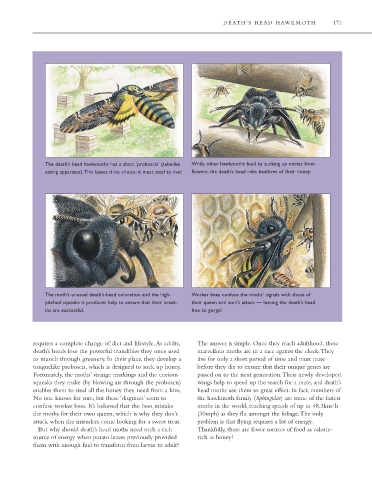
                 The death’s head hawkmoths has a short ‘proboscis’ (tubelike  While other hawkmoths feed by sucking up nectar from
                 eating apparatus).This leaves it no choice: it must steal to live!  flowers, the death’s head robs beehives of their honey.


                 The moth’s unusual death’s-head coloration and the high-  Worker bees confuse the moths’ signals with those of
                 pitched squeaks it produces help to ensure that their break-  their queen and won’t attack — leaving the death’s head
                 ins are successful.                               free to gorge!


             requires a complete change of diet and lifestyle.As adults,  The answer is simple. Once they reach adulthood, these
             death’s heads lose the powerful mandibles they once used  marvellous moths are in a race against the clock.They
             to munch through greenery. In their place, they develop a  live for only a short period of time and must mate
             tonguelike proboscis, which is designed to suck up honey.  before they die to ensure that their unique genes are
             Fortunately, the moths’ strange markings and the curious  passed on to the next generation.Their newly developed
             squeaks they make (by blowing air through the proboscis)  wings help to speed up the search for a mate, and death’s
             enables them to steal all the honey they need from a hive.  head moths use them to great effect. In fact, members of
             No one knows for sure, but these ‘disguises’ seem to    the hawkmoth family (Sphingidae) are some of the fastest
             confuse worker bees. It’s believed that the bees mistake  moths in the world, reaching speeds of up to 48.3km/h
             the moths for their own queen, which is why they don’t  (30mph) as they flit amongst the foliage.The only
             attack when the intruders come looking for a sweet treat.  problem is that flying requires a lot of energy.
              But why should death’s head moths need such a rich     Thankfully, there are fewer sources of food as calorie-
             source of energy when potato leaves previously provided  rich as honey!
             them with enough fuel to transform from larvae to adult?


                                             (c) 2011 Marshall Cavendish. All Rights Reserved.

