


Page 167 - Atlas Of The World's Strangest Animals
P. 167
CUCKOO          167


                                                                    is Eurasian, spending its summers in Europe and Asia and
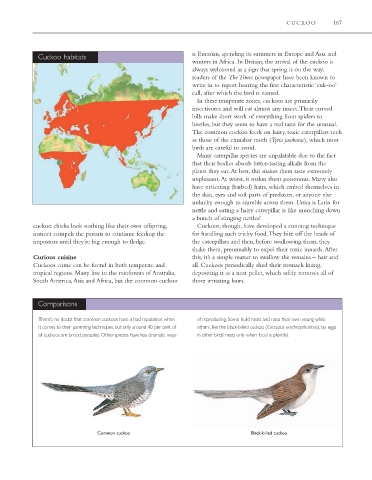
              Cuckoo habitats
                                                                    winters in Africa. In Britain, the arrival of the cuckoo is
                                                                    always welcomed as a sign that spring is on the way:
                                                                    readers of the The Times newspaper have been known to
                                                                    write in to report hearing the first characteristic ‘cuk-oo’
                                                                    call, after which the bird is named.
                                                                     In these temperate zones, cuckoos are primarily
                                                                    insectivores and will eat almost any insect.Their curved
                                                                    bills make short work of everything from spiders to
                                                                    beetles, but they seem to have a real taste for the unusual.
                                                                    The common cuckoo feeds on hairy, toxic caterpillars such
                                                                    as those of the cinnabar moth (Tyria jacobaeae), which most
                                                                    birds are careful to avoid.
                                                                     Many caterpillar species are unpalatable due to the fact
                                                                    that their bodies absorb bitter-tasting alkalis from the
                                                                    plants they eat.At best, this makes them taste extremely
                                                                    unpleasant.At worst, it makes them poisonous. Many also
                                                                    have urticating (barbed) hairs, which embed themselves in
                                                                    the skin, eyes and soft parts of predators, or anyone else
                                                                    unlucky enough to stumble across them. Urtica is Latin for
                                                                    nettle and eating a hairy caterpillar is like munching down
                                                                    a bunch of stinging nettles!
             cuckoo chicks look nothing like their own offspring,    Cuckoos, though, have developed a cunning technique
             instinct compels the parents to continue feeding the   for handling such tricky food.They bite off the heads of
             impostors until they’re big enough to fledge.          the caterpillars and then, before swallowing them, they
                                                                    shake them, presumably to expel their toxic innards.After
             Curious cuisine                                        this, it’s a simple matter to swallow the remains – hair and
             Cuckoos come can be found in both temperate and        all. Cuckoos periodically shed their stomach lining,
             tropical regions. Many live in the rainforests of Australia,  depositing it as a neat pellet, which safely removes all of
             South America,Asia and Africa, but the common cuckoo   those irritating hairs.


              Comparisons

              There’s no doubt that common cuckoos have a bad reputation when  of reproducing. Some build nests and raise their own young while
              it comes to their parenting techniques, but only around 40 per cent of  others, like the black-billed cuckoo (Coccyzus erythropthalmus), lay eggs
              all cuckoos are brood parasites. Other species have less dramatic ways  in other birds’ nests only when food is plentiful.


                                   Common cuckoo                                        Black-billed cuckoo


                                             (c) 2011 Marshall Cavendish. All Rights Reserved.

