


Page 166 - Atlas Of The World's Strangest Animals
P. 166
166      ATLAS  OF THE WORLD’S  STRANGEST ANIMALS


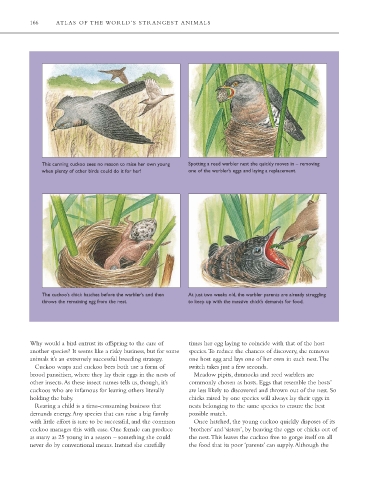
                This cunning cuckoo sees no reason to raise her own young  Spotting a reed warbler nest she quickly moves in – removing
                when plenty of other birds could do it for her!   one of the warbler’s eggs and laying a replacement.


                The cuckoo’s chick hatches before the warbler’s and then  At just two weeks old, the warbler parents are already struggling
                throws the remaining egg from the nest.           to keep up with the massive chick’s demands for food.


           Why would a bird entrust its offspring to the care of  times her egg laying to coincide with that of the host
           another species? It seems like a risky business, but for some  species.To reduce the chances of discovery, she removes
           animals it’s an extremely successful breeding strategy.  one host egg and lays one of her own in each nest.The
             Cuckoo wasps and cuckoo bees both use a form of      switch takes just a few seconds.
           brood parasitism, where they lay their eggs in the nests of  Meadow pipits, dunnocks and reed warblers are
           other insects.As these insect names tells us, though, it’s  commonly chosen as hosts. Eggs that resemble the hosts’
           cuckoos who are infamous for leaving others literally  are less likely to discovered and thrown out of the nest. So
           holding the baby.                                      chicks raised by one species will always lay their eggs in
             Rearing a child is a time-consuming business that    nests belonging to the same species to ensure the best
           demands energy.Any species that can raise a big family  possible match.
           with little effort is sure to be successful, and the common  Once hatched, the young cuckoo quickly disposes of its
           cuckoo manages this with ease. One female can produce   ‘brothers’ and ‘sisters’, by heaving the eggs or chicks out of
           as many as 25 young in a season – something she could  the nest.This leaves the cuckoo free to gorge itself on all
           never do by conventional means. Instead she carefully  the food that its poor ‘parents’ can supply.Although the


                                             (c) 2011 Marshall Cavendish. All Rights Reserved.

