


Page 170 - Atlas Of The World's Strangest Animals
P. 170
170      ATLAS  OF THE WORLD’S  STRANGEST ANIMALS


           Insects are so plentiful and commonplace that it’s easy to
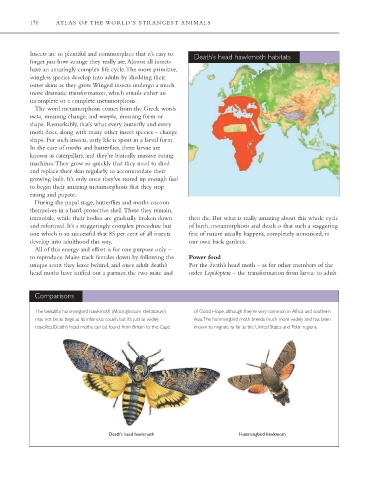
                                                                    Death’s head hawkmoth habitats
           forget just how strange they really are.Almost all insects
           have an amazingly complex life cycle.The more primitive,
           wingless species develop into adults by shedding their
           outer skins as they grow.Winged insects undergo a much
           more dramatic transformation, which entails either an
           incomplete or a complete metamorphosis.
             The word metamorphosis comes from the Greek words
           meta, meaning change, and morphe, meaning form or
           shape. Remarkably, that’s what every butterfly and every
           moth does, along with many other insect species – change
           shape. For such insects, early life is spent in a larval form.
           In the case of moths and butterflies, these larvae are
           known as caterpillars, and they’re basically massive eating
           machines.They grow so quickly that they need to shed
           and replace their skin regularly to accommodate their
           growing bulk. It’s only once they’ve stored up enough fuel
           to begin their amazing metamorphosis that they stop
           eating and pupate.
             During the pupal stage, butterflies and moths cocoon
           themselves in a hard, protective shell.There they remain,
           immobile, while their bodies are gradually broken down  then die. But what is really amazing about this whole cycle
           and reformed. It’s a staggeringly complex procedure but  of birth, metamorphosis and death is that such a staggering
           one which is so successful that 85 per cent of all insects  feat of nature usually happens, completely unnoticed, in
           develop into adulthood this way.                       our own back gardens.
             All of this energy and effort is for one purpose only –
           to reproduce. Males track females down by following the  Power food
           unique scent they leave behind, and once adult death’s  For the death’s head moth – as for other members of the
           head moths have sniffed out a partner, the two mate and  order Lepidoptera – the transformation from larvae to adult


             Comparisons


             The beautiful hummingbird hawkmoth (Macroglossum stellatarum)  of Good Hope, although they’re very common in Africa and southern
             may not be as large as its infamous cousin, but it’s just as widely  Asia.The hummingbird moth breeds much more widely and has been
             travelled. Death’s head moths can be found from Britain to the Cape  known to migrate as far as the United States and Polar regions.


                                       Death’s head hawkmoth                        Hummingbird hawkmoth


                                             (c) 2011 Marshall Cavendish. All Rights Reserved.

