


Page 196 - Atlas Of The World's Strangest Animals
P. 196
196      ATLAS  OF THE WORLD’S  STRANGEST ANIMALS


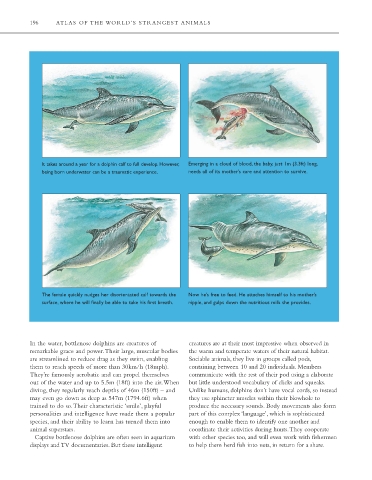
                It takes around a year for a dolphin calf to full develop. However,  Emerging in a cloud of blood, the baby,just 1m (3.3ft) long,
                being born underwater can be a traumatic experience.  needs all of its mother’s care and attention to survive.


                The female quickly nudges her disorientated calf towards the  Now he’s free to feed. He attaches himself to his mother’s
                surface,where he will finally be able to take his first breath.  nipple, and gulps down the nutritious milk she provides.


           In the water, bottlenose dolphins are creatures of     creatures are at their most impressive when observed in
           remarkable grace and power.Their large, muscular bodies  the warm and temperate waters of their natural habitat.
           are streamlined to reduce drag as they swim, enabling  Sociable animals, they live in groups called pods,
           them to reach speeds of more than 30km/h (18mph).      containing between 10 and 20 individuals. Members
           They’re famously acrobatic and can propel themselves   communicate with the rest of their pod using a elaborate
           out of the water and up to 5.5m (18ft) into the air.When  but little understood vocabulary of clicks and squeaks.
           diving, they regularly reach depths of 46m (150ft) – and  Unlike humans, dolphins don’t have vocal cords, so instead
           may even go down as deep as 547m (1794.6ft) when       they use sphincter muscles within their blowhole to
           trained to do so.Their characteristic ‘smile’, playful  produce the necessary sounds. Body movements also form
           personalities and intelligence have made them a popular  part of this complex ‘language’, which is sophisticated
           species, and their ability to learn has turned them into  enough to enable them to identify one another and
           animal superstars.                                     coordinate their activities during hunts.They cooperate
             Captive bottlenose dolphins are often seen in aquarium  with other species too, and will even work with fishermen
           displays and TV documentaries. But these intelligent   to help them herd fish into nets, in return for a share.


                                             (c) 2011 Marshall Cavendish. All Rights Reserved.

