


Page 200 - Atlas Of The World's Strangest Animals
P. 200
200      ATLAS  OF THE WORLD’S  STRANGEST ANIMALS


           The poet Alfred Lord Tennyson (1809–92) famously said
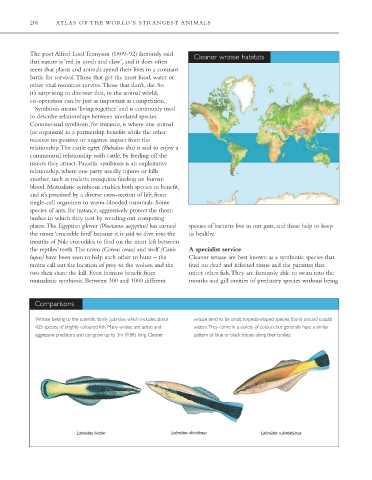
                                                                    Cleaner wrasse habitats
           that nature is ‘red in tooth and claw’, and it does often
           seem that plants and animals spend their lives in a constant
           battle for survival.Those that get the most food, water or
           other vital resources survive.Those that don’t, die. So
           it’s surprising to discover that, in the animal world,
           co-operation can be just as important as competition.
             Symbiosis means ‘living together’ and is commonly used
           to describe relationships between unrelated species.
           Commensual symbiosis, for instance, is where one animal
           (or organism) in a partnership benefits while the other
           receives no positive or negative impact from the
           relationship.The cattle egret (Bubulcus ibis) is said to enjoy a
           commensual relationship with cattle, by feeding off the
           insects they attract. Parasitic symbiosis is an exploitative
           relationship, where one party usually injures or kills
           another, such as malaria mosquitos feeding on human
           blood. Mutualistic symbiosis enables both species to benefit,
           and it’s practised by a diverse cross-section of life, from
           single-cell organisms to warm-blooded mammals. Some
           species of ants, for instance, aggressively protect the thorn
           bushes in which they nest by weeding out competing
           plants.The Egyptian plover (Pluvianus aegyptius) has earned  species of bacteria live in our guts, and these help to keep
           the name ‘crocodile bird’ because it is said to dive into the  us healthy.
           mouths of Nile crocodiles to feed on the meat left between
           the reptiles’ teeth.The raven (Corvus corax) and wolf (Canis  A specialist service
           lupus) have been seen to help each other to hunt – the  Cleaner wrasse are best known as a symbiotic species that
           ravens call out the location of prey to the wolves, and the  feed on dead and infected tissue and the parasites that
           two then share the kill. Even humans benefit from      infect other fish.They are famously able to swim into the
           mutualistic symbiosis. Between 300 and 1000 different  mouths and gill cavities of predatory species without being


             Comparisons

             Wrasse belong to the scientific family Labridae, which includes about  wrasse tend to be small, torpedo-shaped species, found around coastal
             425 species of brightly coloured fish. Many wrasse are active and  waters.They come in a variety of colours but generally have a similar
             aggressive predators and can grow up to 3m (9.8ft) long. Cleaner  pattern of blue or black stripes along their bodies.


                            Labroides bicolor               Labroides dimidiatus           Labroides rubrolabiatus


                                             (c) 2011 Marshall Cavendish. All Rights Reserved.

