


Page 197 - Atlas Of The World's Strangest Animals
P. 197
BOTTLENOSE DOLPHIN               197


              Dolphins are also one of the few species that are      Dolphins are conscious breathers, which means that they
             recognized as tool-users.A family of bottlenose dolphins  have to remember to breathe, unlike humans who do it
             from Australia’s Shark Bay famously use sponges to protect  unconsciously.When they dive, they take a breath using an
             their sensitive snouts when foraging for fish on the   opening on top of their head, called a blowhole, to suck in
             abrasive sea bed!                                      air. Once underwater, they have to hold that breath or
                                                                    they’ll drown.Thanks to millions of years of evolution,
             Don’t forget to breathe!                               dolphins are efficient breathers and can exchange 80 per
             There are two known species of bottlenose dolphin – the  cent of the air in their lungs with each breath, compared
             common and the Indo-Pacific (Tursiops aduncus). These  to humans who can exchange only 17 per cent.This
             charismatic cetaceans are air-breathing mammals whose  allows them to stay submerged for up to 30 minutes at a
             bodies have adapted to a completely aquatic life.      time.When they sleep, another incredible adaptation kicks
                                                                    in. It is believed that half of their brain sleeps at a time, so
                                                                    that the other half remains alert to do the breathing!
              Bottlenose dolphin habitats                            However, the dolphins’ oddest adaptation for an aquatic
                                                                    life is echolocation. Echolocation enables them to hunt
                                                                    even in the depths of the oceans where there is little light,
                                                                    as well as to communicate with each other over vast
                                                                    distances. Bats also use echolocation, and dolphins use
                                                                    similar clicking sounds to build-up a 3D ‘picture’ of the
                                                                    world around them.These clicks are passed through the
                                                                    dolphins’ forehead (called the melon), which is filled with
                                                                    fatty tissue and fluid.This acts like a lens, focusing sounds
                                                                    in different directions.When these sounds hit an object,
                                                                    echoes are received back through the dolphin’s lower jaw,
                                                                    and this information is then passed to the brain for
                                                                    processing. It’s an extremely efficient – if strange – method
                                                                    of finding your way around.


              Comparisons

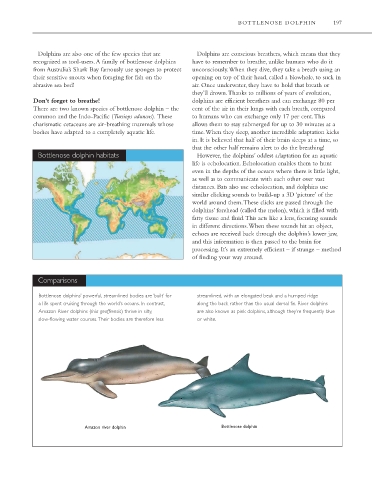
              Bottlenose dolphins’ powerful, streamlined bodies are ‘built’ for   streamlined, with an elongated beak and a humped ridge
              a life spent cruising through the world’s oceans. In contrast,  along the back rather than the usual dorsal fin. River dolphins
              Amazon River dolphins (Inia geoffrensis) thrive in silty,  are also known as pink dolphins, although they’re frequently blue
              slow-flowing water courses.Their bodies are therefore less  or white.


                              Amazon river dolphin                            Bottlenose dolphin


                                             (c) 2011 Marshall Cavendish. All Rights Reserved.

