


Page 50 - Atlas Of The World's Strangest Animals
P. 50
50       ATLAS  OF THE WORLD’S  STRANGEST ANIMALS


                                                                  These amazing proboscises can be up to 18cm (7in) long
             Proboscis monkey habitats
                                                                  and hang down over the mouth like a deflated balloon.
                                                                  Only the males have such large noses. Females have
                                                                  smaller, more delicate protuberances, although they’re still
                                                                  big for primates. However, in the world of the proboscis
                                                                  monkey, size is everything.The bigger the male’s nose, the
                                                                  more attractive he appears to the opposite sex.


                                                                  Water Lovers
                                                                  Unlike most primates, proboscis monkeys are just as
                                                                  comfortable in the water as in the tree tops – they even
                                                                  have partially webbed feet.These water-lovers therefore
                                                                  make their homes around flooded, lowland swamps where
                                                                  a wide range of food can be found. Such wetlands may
                                                                  provide easy pickings for a hungry herbivore, but they can
                                                                  also be dangerous places to live.When trouble strikes,
                                                                  proboscis monkeys will often drop into the water and
                                                                  swim to safety, but this isn’t always a good plan! One of
           When Dutch settlers arrived in Indonesia in the 1600s, the  the species’ main predators are false gharials (Tomistoma
           locals noticed something that made them laugh. Many of  schlegelii), which often take immature monkeys from the
           the new arrivals had big noses and big bellies, just like the  water and will even pluck them from low branches.
           native monkeys.And that is why one of the local        Luckily, that big nose has other uses besides attracting a
           nicknames for the proboscis monkey is orang belanda,   mate. It works like an echo chamber, enabling males to
           which means ‘Dutchman’!                                produce startlingly loud honking sounds to warn off
             Undoubtedly the most prominent feature of these      predators.When they’re especially agitated, their nose
           reddish-brown primates are their huge, extended noses.  swells with blood, producing louder and deeper calls.


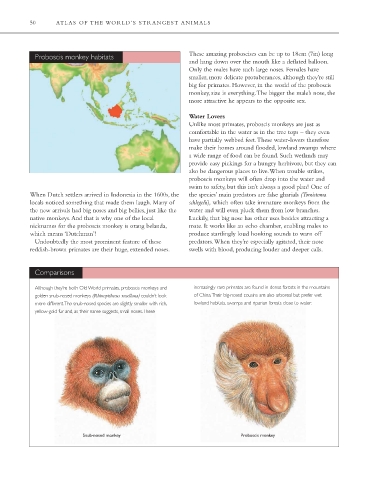
             Comparisons


             Although they’re both Old World primates, proboscis monkeys and  increasingly rare primates are found in dense forests in the mountains
             golden snub-nosed monkeys (Rhinopithecus roxellana) couldn’t look  of China.Their big-nosed cousins are also arboreal but prefer wet
             more different.The snub-nosed species are slightly smaller with rich,  lowland habitats, swamps and riparian forests close to water.
             yellow-gold fur and, as their name suggests, small noses.These


                              Snub-nosed monkey                                     Proboscis monkey


                                             (c) 2011 Marshall Cavendish. All Rights Reserved.

