


Page 47 - Atlas Of The World's Strangest Animals
P. 47
MUDSKIPPER            47


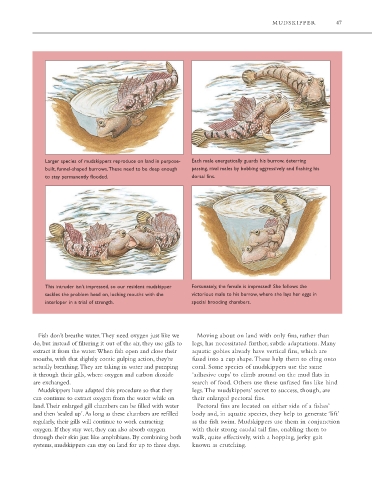
                 Larger species of mudskippers reproduce on land in purpose-  Each male energetically guards his burrow, deterring
                 built, funnel-shaped burrows.These need to be deep enough  passing, rival males by bobbing aggressively and flashing his
                 to stay permanently flooded.                      dorsal fins.


                 This intruder isn’t impressed, so our resident mudskipper  Fortunately, the female is impressed! She follows the
                 tackles the problem head on, locking mouths with the  victorious male to his burrow, where she lays her eggs in
                 interloper in a trial of strength.                special brooding chambers.


              Fish don’t breathe water.They need oxygen just like we  Moving about on land with only fins, rather than
             do, but instead of filtering it out of the air, they use gills to  legs, has necessitated further, subtle adaptations. Many
             extract it from the water.When fish open and close their  aquatic gobies already have vertical fins, which are
             mouths, with that slightly comic gulping action, they’re  fused into a cup shape.These help them to cling onto
             actually breathing.They are taking in water and pumping  coral. Some species of mudskippers use the same
             it through their gills, where oxygen and carbon dioxide   ‘adhesive cups’ to climb around on the mud flats in
             are exchanged.                                         search of food. Others use these unfused fins like hind
              Mudskippers have adapted this procedure so that they  legs.The mudskippers’ secret to success, though, are
             can continue to extract oxygen from the water while on  their enlarged pectoral fins.
             land.Their enlarged gill chambers can be filled with water  Pectoral fins are located on either side of a fishes’
             and then ‘sealed up’.As long as these chambers are refilled  body and, in aquatic species, they help to generate ‘lift’
             regularly, their gills will continue to work extracting  as the fish swim. Mudskippers use them in conjunction
             oxygen. If they stay wet, they can also absorb oxygen  with their strong caudal tail fins, enabling them to
             through their skin just like amphibians. By combining both  walk, quite effectively, with a hopping, jerky gait
             systems, mudskippers can stay on land for up to three days.  known as crutching.


                                             (c) 2011 Marshall Cavendish. All Rights Reserved.

