


Page 46 - Atlas Of The World's Strangest Animals
P. 46
46       ATLAS  OF THE WORLD’S  STRANGEST ANIMALS


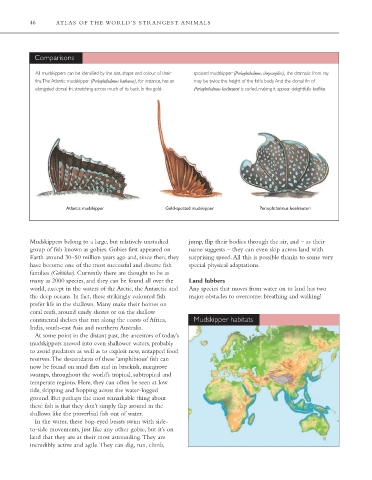
             Comparisons

             All mudskippers can be identified by the size, shape and colour of their  spotted mudskipper (Periophthalmus chrysospilos), the dramatic front ray
             fins.The Atlantic mudskipper (Periophthalmus barbarus), for instance, has an  may be twice the height of the fish’s body.And the dorsal fin of
             elongated dorsal fin, stretching across much of its back. In the gold-  Periophthalmus koelreuteri is curled, making it appear delightfully leaflike.


                        Atlantic mudskipper               Gold-spotted mudskipper          Periophthalmus koelreuteri


           Mudskippers belong to a large, but relatively unstudied  jump, flip their bodies through the air, and – as their
           group of fish known as gobies. Gobies first appeared on  name suggests – they can even skip across land with
           Earth around 30–50 million years ago and, since then, they  surprising speed.All this is possible thanks to some very
           have become one of the most successful and diverse fish  special physical adaptations.
           families (Gobiidae). Currently there are thought to be as
           many as 2000 species, and they can be found all over the  Land lubbers
           world, except in the waters of the Arctic, the Antarctic and  Any species that moves from water on to land has two
           the deep oceans. In fact, these strikingly coloured fish  major obstacles to overcome: breathing and walking!
           prefer life in the shallows. Many make their homes on
           coral reefs, around sandy shores or on the shallow
           continental shelves that run along the coasts of Africa,  Mudskipper habitats
           India, south-east Asia and northern Australia.
             At some point in the distant past, the ancestors of today’s
           mudskippers moved into even shallower waters, probably
           to avoid predators as well as to exploit new, untapped food
           reserves.The descendants of these ‘amphibious’ fish can
           now be found on mud flats and in brackish, mangrove
           swamps, throughout the world’s tropical, subtropical and
           temperate regions. Here, they can often be seen at low
           tide, skipping and hopping across the water-logged
           ground. But perhaps the most remarkable thing about
           these fish is that they don’t simply flap around in the
           shallows like the proverbial fish out of water.
             In the water, these bog-eyed beasts swim with side-
           to-side movements, just like any other gobie, but it’s on
           land that they are at their most astounding.They are
           incredibly active and agile.They can dig, run, climb,


                                             (c) 2011 Marshall Cavendish. All Rights Reserved.

