


Page 84 - Atlas Of The World's Strangest Animals
P. 84
84       ATLAS  OF THE WORLD’S  STRANGEST ANIMALS


                                                                  male kangaroo can jump up to 9m (30ft) in one leap. So,
             Red kangaroo habitats
                                                                  though this is a strange method of locomotion, it lets
                                                                  kangaroos reach speeds of over 56km/h (35mph). Even
                                                                  ‘cruising speed’ is an impressive 20-25km/h (13-16mph).
                                                                    They can reach such staggering speeds due to the
                                                                  combination of powerful legs and long, hind feet. On each
                                                                  hind foot is an enlarged fourth toe.This is lined up with
                                                                  the kangaroo’s leg bone which, in turn, is anchored by
                                                                  ‘elastic’ tendons more than 1cm (0.4in) thick.When ’roos
                                                                  hop, both hind feet hit the ground simultaneously.The
                                                                  effect is like someone pushing down on a huge spring.
                                                                  Relax, and the tension is released and the kangaroo
                                                                  ‘ricochets’ forwards.
                                                                    But why hop rather than walk? There’s some evidence
                                                                  that kangaroos didn’t always move around in such a
                                                                  dramatic fashion. Fossils seem to show that it was the
                                                                  development of their over-sized fourth toe that gave them
                                                                  the ability to bound. Once this happened, ’roos never
                                                                  looked back.Although it may look like an extremely tiring
                                                                  way to get around, hopping is very efficient: the faster they
           For a kangaroo, walking is quite a tricky process.To do so,  move, the more efficiently their bodies work. In fact,
           ’roos must swing their huge, hind legs forwards, while  modern-day kangaroos have no choice but to hop
           supporting their body on their short arms and powerful  because, except when they swim, their hind legs can’t
           tail. It’s an ungainly method of getting about and belies the  move independently.
           fact that, at speed, these great Australian animals are truly
           awesome.Then, they bound, like some impossibly giant   Beanie babies
           rabbit, with their hind legs propelling them forwards, and  It took almost 300 years for scientists to discover exactly
           their tails held almost horizontally as a counterweight.A  how baby kangaroos are born and reach the pouch. Even


             Comparisons

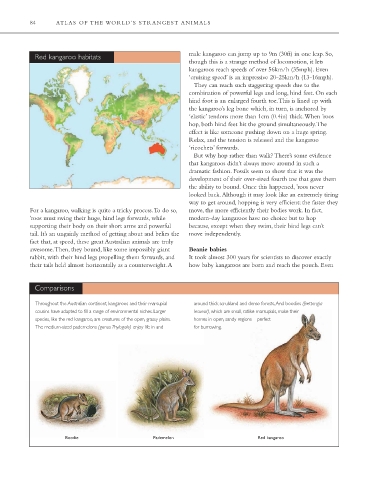
             Throughout the Australian continent, kangaroos and their marsupial  around thick scrubland and dense forests.And boodies (Bettongia
             cousins have adapted to fill a range of environmental niches. Larger  lesueur), which are small, ratlike marsupials, make their
             species, like the red kangaroo, are creatures of the open, grassy plains.  homes in open, sandy regions – perfect
             The medium-sized pademelons (genus Thylogale) enjoy life in and  for burrowing.


                        Boodie                        Pademelon                           Red kangaroo


                                             (c) 2011 Marshall Cavendish. All Rights Reserved.

