


Page 641 - The Book of Caterpillars: A Life-Size Guide to Six Hundred Species From Around the World
P. 641
MOTH CATERPILLARS

                      FAMILY  Noctuidae
                  DISTRIBUTION  Europe (including Iceland, Scotland, and southern Scandinavia),
                           east across southern Russia to Russian Far East; Canary Islands,
                           northwest Africa, Asia Minor, the Caucasus, the Middle East, and
                           across central Asia to Korea and Japan
                     HABITAT  Northern moorlands, marshes, and upland pastures; also
                           warm rocky slopes, open woodlands, lowland heathlands,
                           and scrubby grasslands
                  HOST PLANTS  Many, including buttercup (Ranunculus spp.), hawk’s-beard
                           (Crepis spp.), dock (Rumex spp.), knapweed (Centaurea spp.),
                           Bramble (Rubus fruticosus), and Bog Myrtle (Myrica gale)
                      NOTE  Beautifully marked caterpillar that can be found by day
             CONSERVATION STATUS  Not evaluated


                                                                                   ADULT WINGSPAN
                                                                                  2 ⁄  –2½ in (52–64 mm)
                                                                                  CATERPILLAR LENGTH
                                                                                  2⅜–2 ⁄   in (60–65 mm)
            XYLENA EXSOLETA
            SWORD-GRASS                                                                          639

            (LINNAEUS, 1758)


            Sword-grass caterpillars hatch from brownish-yellow eggs
            laid in batches on low vegetation, in May, and are fully fed in
            July, when they form a pupa in a delicate cocoon in the ground.
            It does not always hide by day, even when large, and feeds openly
            by both day and night. There is a single generation, with the
            adults emerging in the fall, overwintering, then mating and
            living until May.


            In the  nal instar, the strikingly marked Sword-grass caterpillar,

            with bold black, orange, yellow, and white markings, those on
            the back often like bicycle chain links, is usually unmistakable.
            However, the black-and-orange markings vary and do not
            appear until the  nal instar, so the caterpillar can resemble other

            noctuids, such as the closely related Red Sword-grass (Xylena
            vetusta), although that species’ red or yellow spiracles di er from

            the whitish ones of X. exsoleta. The Sword-grass common name
            refers to an old term for sedge (Cyperaceae), thought to be the

            larval food plant when the species was  rst described.


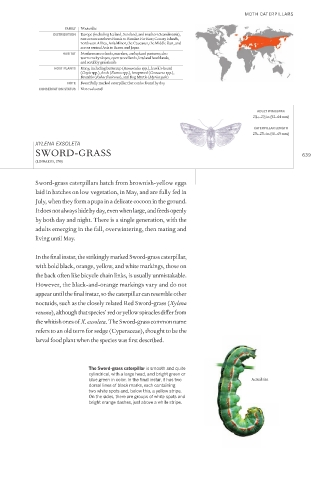
                             The Sword-grass caterpillar is smooth and quite
                             cylindrical, with a large head, and bright green or
                             blue green in color. In the   nal instar, it has two   Actual size
                             dorsal lines of black marks, each containing
                             two white spots and, below this, a yellow stripe.
                             On the sides, there are groups of white spots and
                             bright orange dashes, just above a white stripe.

