


Page 639 - The Book of Caterpillars: A Life-Size Guide to Six Hundred Species From Around the World
P. 639
MOTH CATERPILLARS

                      FAMILY  Noctuidae
                  DISTRIBUTION  North America, South America, Europe (except northern
                           Scandinavia), much of Africa, and across Asia to China, Japan,
                           Southeast Asia, and Malay Archipelago
                     HABITAT  Diverse, including tropical, subtropical, and temperate
                           agricultural land
                  HOST PLANTS  Crucifers such as Cabbage (Brassica oleracea) and relatives; Beet
                           (Beta vulgaris); cucurbits, such as watermelon (Citrullus lanatus);
                           and solanaceous plants, such as Potato (Solanum tuberosum),
                           Tomato (Solanum lycopersicum), and Tobacco (Nicotiana tabacum)
                      NOTE  Looper caterpillar with distinctive vestigal prolegs on two
                           abdominal segments
             CONSERVATION STATUS  Not evaluated, but common


                                                                                   ADULT WINGSPAN
                                                                                  1 ⁄  –1½ in (33–38 mm)
                                                                                  CATERPILLAR LENGTH
                                                                                  1 ⁄  –1 ⁄   in (30–40 mm)
            TRICHOPLUSIA NI
            CABBAGE LOOPER                                                                       637

            (HÜBNER, [1803])


            Cabbage Looper caterpillars hatch from yellowish-white or
            greenish eggs laid singly or in small groups on either side of a
            leaf. In early instars, they feed on the lower leaf surface but in

            the fourth and  fth instars make large holes in the center of host
            plant leaves. In cabbage, they can bore into the developing head,
            damage seedlings, or feed on wrapper leaves. They can consume
            three times their body weight daily, growing from egg to pupa in
            as little as 20 days; in some locations, there are seven generations
            per year. The fragile white cocoons are found under leaves,
            in leaf litter, or in soil.


            Adults may migrate as far as 125 miles (200 km) from their
            breeding site; this, together with their polyphagous feeding,
            accounts for the species’ extensive range. The caterpillars
            damage cruciferous crops and may occasionally attack many
            others. In addition to pesticides, their spread can be controlled
            by their natural enemies—wasp parasitoids, such as Copidosoma
            truncatellus, and tachinid  ies, such as Voria ruralis. A nuclear

            polyhedrosis virus can also kill more than 40 percent of a
            caterpillar population.


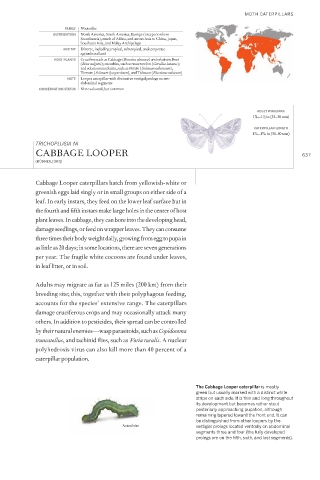
                                                                The Cabbage Looper caterpillar is mostly
                                                                green but usually marked with a distinct white
                                                                stripe on each side. It is thin and long throughout
                                                                its development but becomes rather stout
                                                                posteriorly approaching pupation, although
                                                                remaining tapered toward the front end. It can
                                                                be distinguished from other loopers by the
                                        Actual size             vestigial prolegs located ventrally on abdominal
                                                                segments three and four (the fully developed
                                                                prolegs are on the   fth, sixth, and last segments).

